Binance’s Security Breach: Frozen Is Not Recovered
The developing Binance breach: an estimated $6.3 billion impact, reported asset freezes, preliminary forensic analysis and why frozen funds are not a final loss tally.
Explore the five-scene explainerKey takeaways
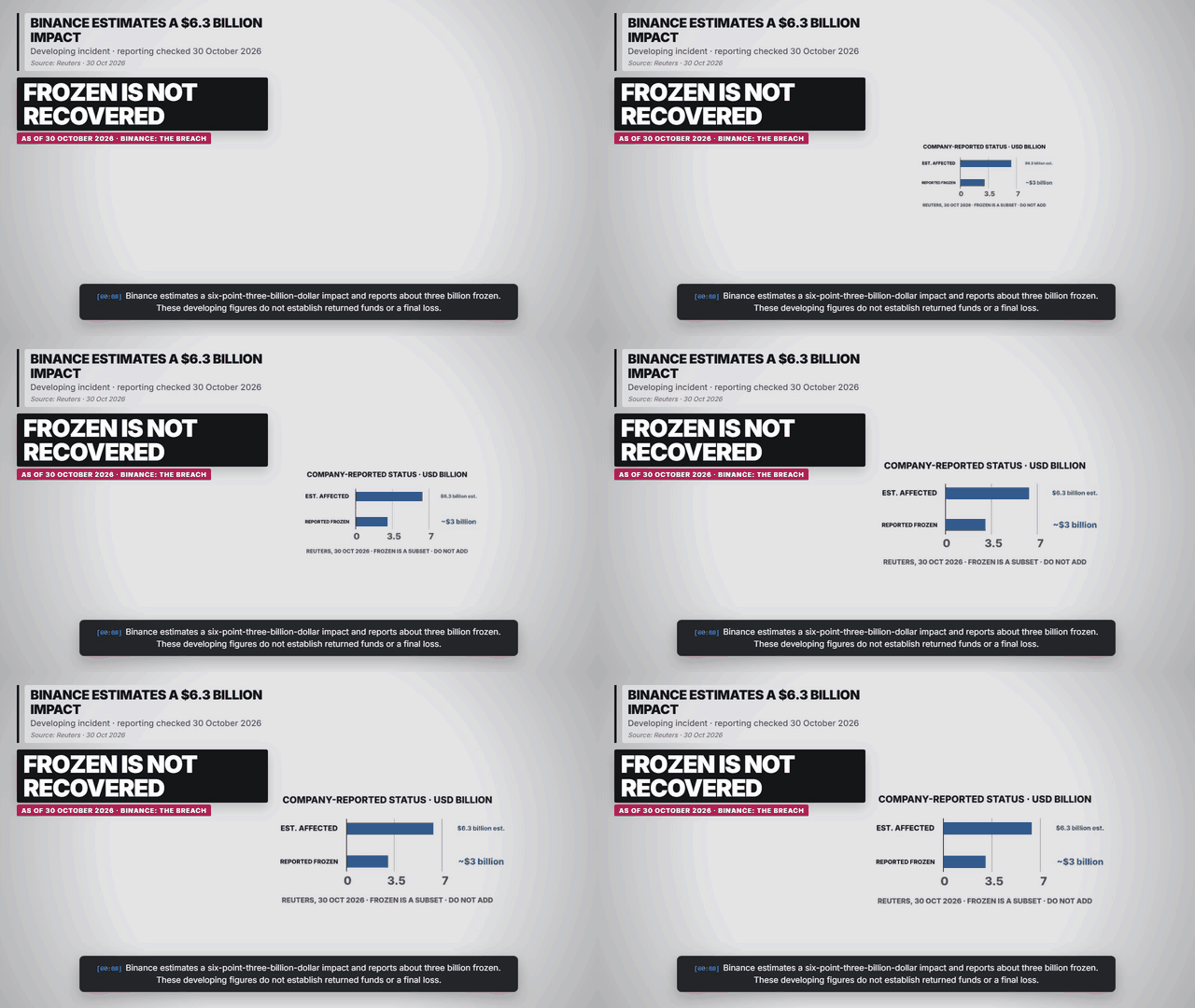
- Binance’s estimated impact and the reported frozen amount describe different measures.
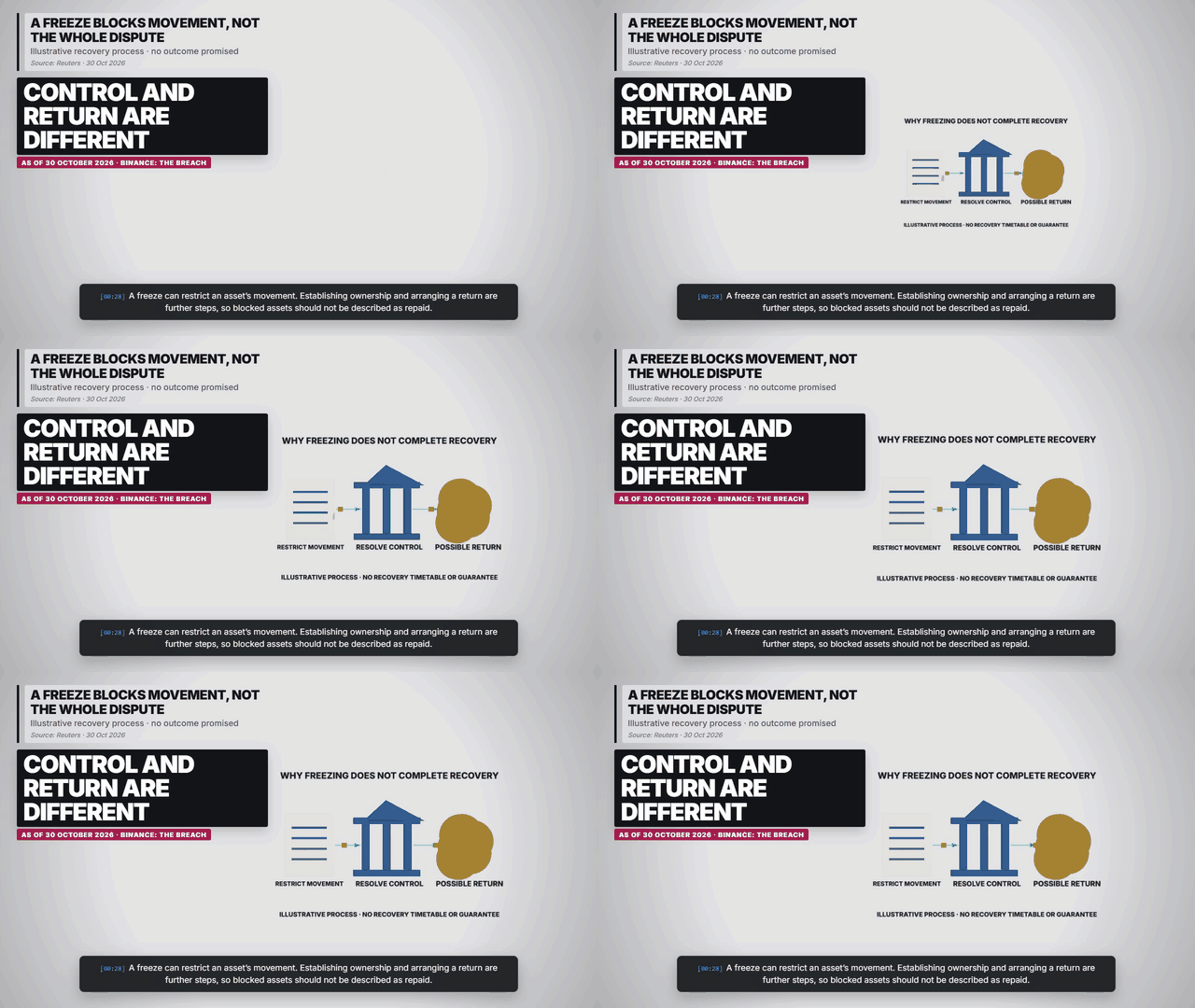
- Blocking movement does not establish that an asset has been returned to its owner.
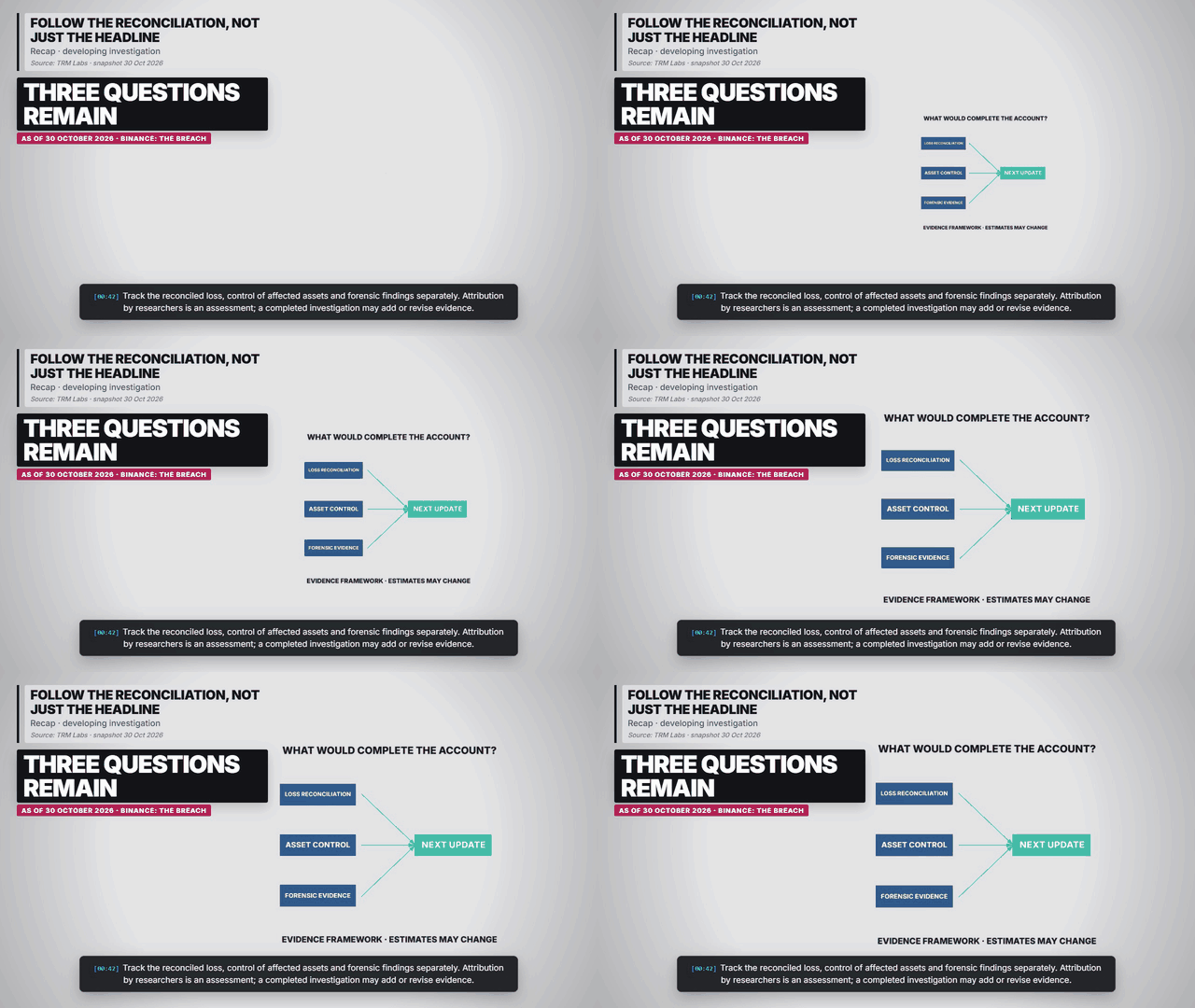
- The cause, attribution and final loss require separately qualified evidence as the investigation develops.
Sourced facts and status
| Period | Fact or status | Source |
|---|---|---|
| Company account, reported 30 October 2026 | Approximately $6.3 billion estimated impact; not a final loss after recoveries. | Reuters: Binance impact and asset freezes |
| Company freeze efforts, reported 30 October | About $3 billion located through asset-freeze efforts; this does not establish return to users. | Reuters: Binance impact and asset freezes |
| TRM observations to 30 October, 00:30 UTC | TRM separately estimates $6.36 billion outflows and roughly $2.7 billion frozen. Different snapshot and valuation; not combined with the company figures. | TRM Labs: Dated forensic assessment |
| Attribution, preliminary | TRM attributes the attack to TraderTraitor with high confidence. This is its assessment, not a finding established by this page. | TRM Labs: Dated forensic assessment |
Estimated impact
Binance estimates a six-point-three-billion-dollar impact and reports about three billion frozen. These developing figures do not establish returned funds or a final loss. Source and context.
The evidence
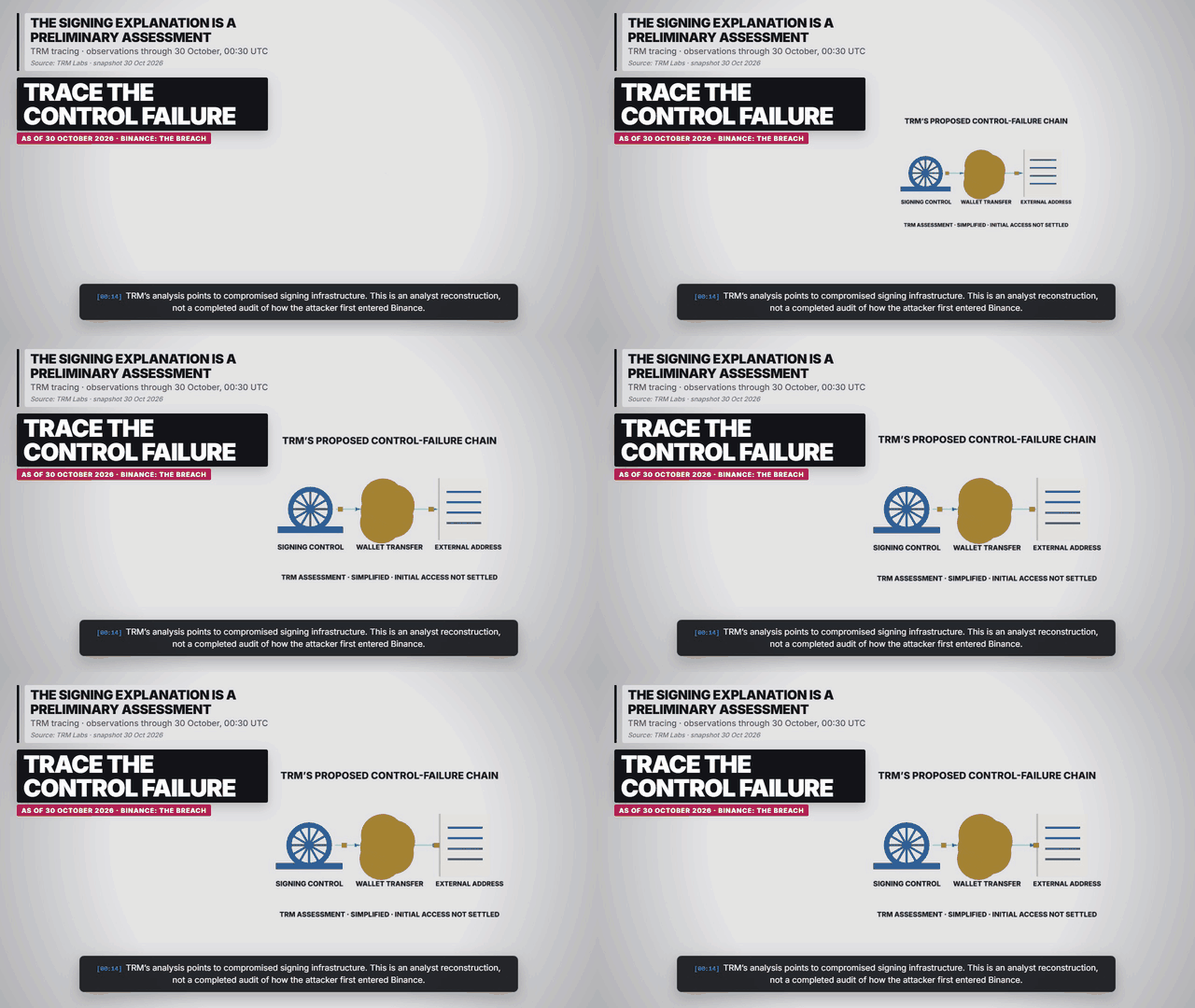
TRM’s analysis points to compromised signing infrastructure. This is an analyst reconstruction, not a completed audit of how the attacker first entered Binance. Source and context.
Asset controls
A freeze can restrict an asset’s movement. Establishing ownership and arranging a return are further steps, so blocked assets should not be described as repaid. Source and context.
Recap
Track the reconciled loss, control of affected assets and forensic findings separately. Attribution by researchers is an assessment; a completed investigation may add or revise evidence. Source and context.
Charts, maps and diagrams from the explainer
Frequently asked questions
Does $3 billion frozen mean $3 billion recovered?
No. A restriction on movement does not by itself establish that ownership is resolved or funds have been returned.
Can the remaining loss be calculated by subtracting the headline figures?
No final net loss is established here. The estimates have different scopes, timing and valuation, and recovery remains unresolved.
Has the attacker’s identity been established?
TRM attributes the attack to North Korea’s TraderTraitor with high confidence. This page attributes that conclusion to TRM and treats the investigation as developing.
Sources and reporting scope
Reuters: Binance impact and asset freezes. 2026-10-30. Reuters report updated 03:39 UTC; Euronext displays 04:39. Binance estimated approximately $6.3 billion impact and reported about $3 billion located through freeze efforts. Developing figures, not final recovered losses.
TRM Labs: Dated forensic assessment. 2026-10-29. Page dated 29 October; analysis includes on-chain observations as of 30 October at 00:30 UTC. TRM’s tracing, signing-infrastructure explanation and TraderTraitor attribution are its assessment. Its $6.36 billion estimate and roughly $2.7 billion frozen use its own snapshot and valuation.
As of 30 October 2026, morning reporting. The incident began 29 October and the investigation is developing. Company estimates and TRM’s separately timed tracing are distinct. Frozen assets are not confirmed returned funds; no final net loss is calculated. Attribution remains an analyst assessment. Re-check before re-rendering.