Pix: How Brazil Pays in Seconds
How Brazil’s Pix moves money in seconds: shared infrastructure, payment keys, usage, fees, recurring bills and fraud safeguards. Official sources checked 25 October 2026.
▶ Explore the narrated graphic explainerKey takeaways
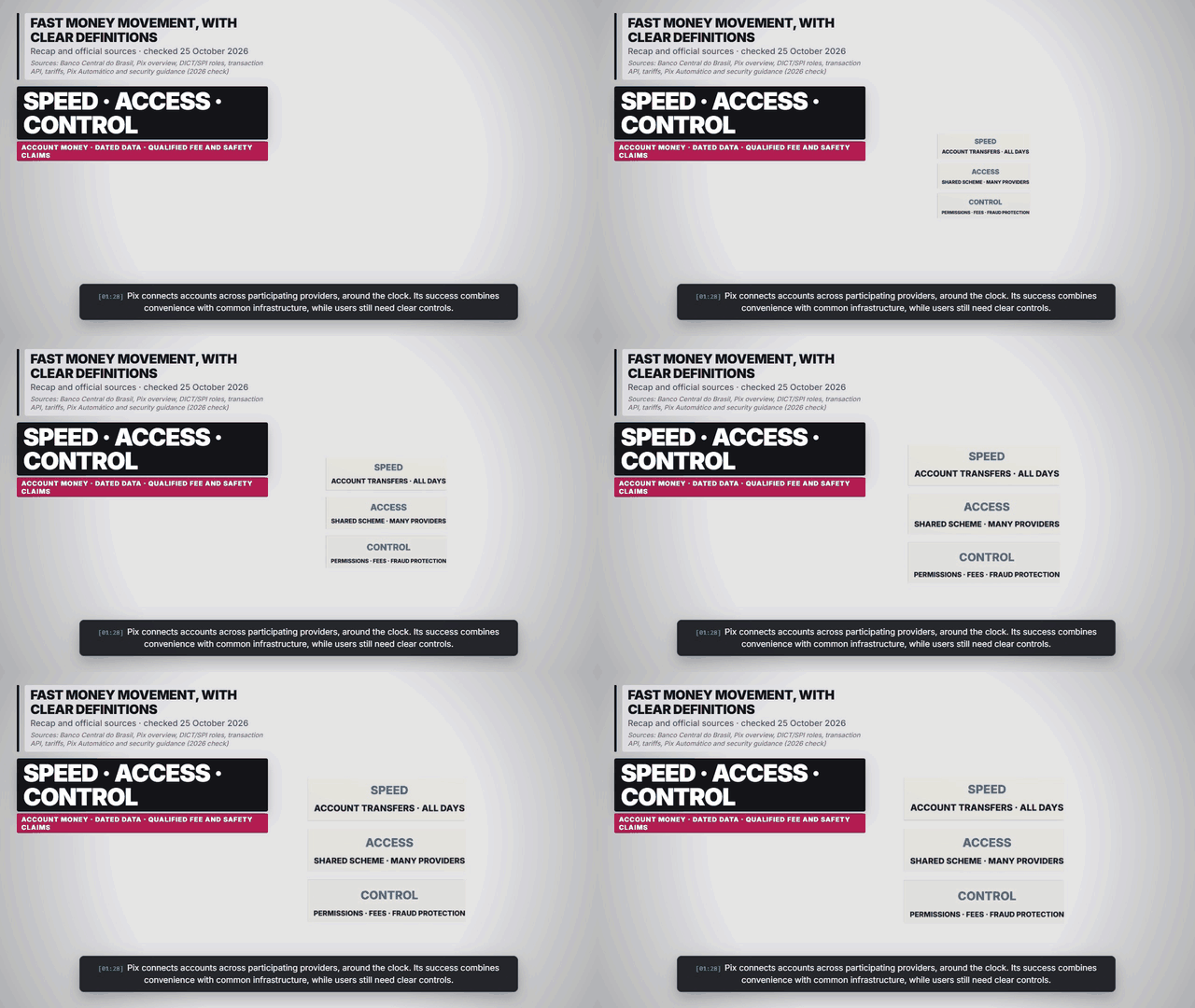
- Pix transfers account money across participating banks and payment providers, in seconds and on all days.
- The addressing directory and settlement system do different jobs. A registered key is not a person or a payment.
- Billions of transactions do not equal billions of users. Chart coverage and fee exceptions matter.
- Recurring payments need authorization, while fraud recovery remains conditional.
The dated figures and definitions
| Period or feature | Figure or rule | Scope | Source |
|---|---|---|---|
| 16 November 2020 | Pix launch | BCB’s stated operational start | Banco Central do Brasil: Pix overview |
| Sep 2024 | 4.89 billion | SPI-settled Pix transactions in September; internal settlement excluded | BCB open data: Pix statistics and coverage |
| Sep 2025 | 6.13 billion | SPI-settled Pix transactions in September; internal settlement excluded | BCB open data: Pix statistics and coverage |
| Sep 2026 | 7.17 billion | SPI-settled Pix transactions in September; internal settlement excluded | BCB open data: Pix statistics and coverage |
| 24/7 | Service availability | Every day including holidays; not a measured uptime percentage | Banco Central do Brasil: Pix overview |
| Pix Automático | Prior permission | Recurring payments with authorization controls | BCB: Pix Automático operational procedures, IN 513 |
| MED | Conditional recovery | Review and available funds; no guaranteed refund | BCB: Segurança no Pix |
What changes when a payment takes seconds?
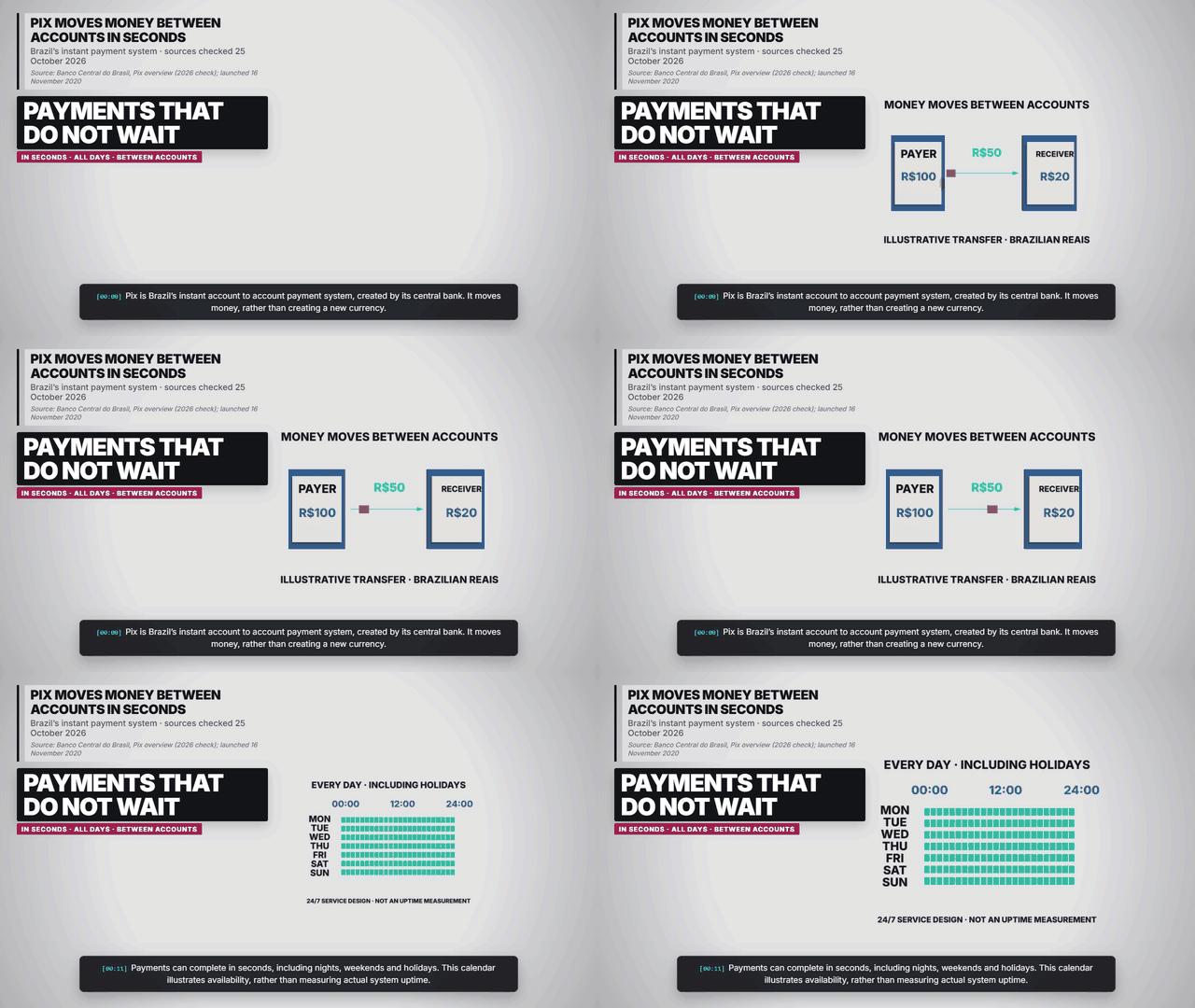
Pix lets people, businesses and public bodies transfer money between participating accounts without waiting for the next working day. Banco Central do Brasil gives 16 November 2020 as its operational start. The scheme works with bank and payment accounts; it is not a separate currency. The opening animation uses an illustrative R$50 transfer, with the sender and receiver’s combined balance unchanged. It is an explanation of money movement, not a live transaction. Source: Banco Central do Brasil: Pix overview.
How does a key find the right account?
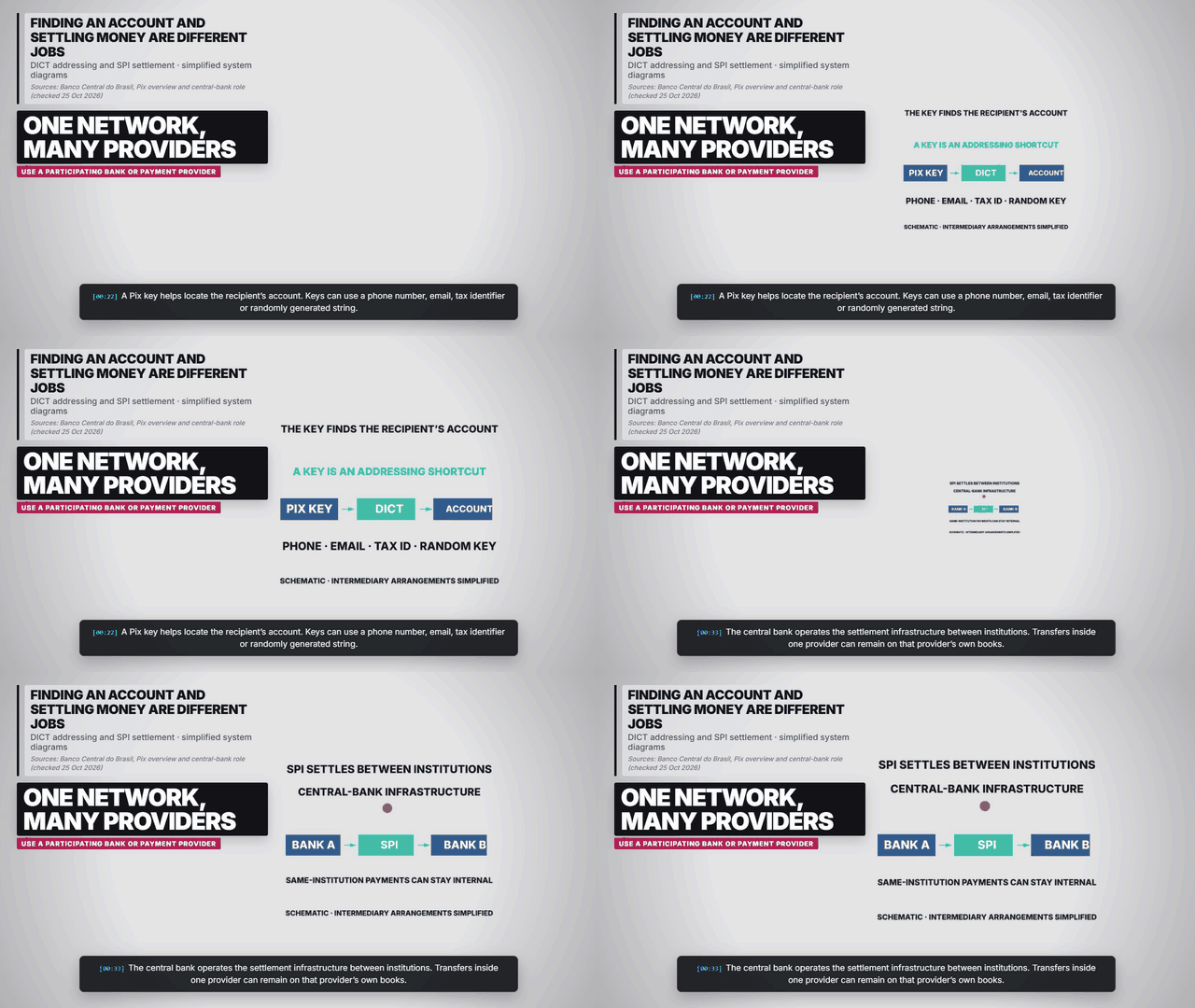
A key is an addressing shortcut linked to account information. Supported types include a phone number, email, tax identifier and a random string. A person can have more than one key, so registrations are not a count of unique people. Keys are optional for initiating payments: QR codes or account details provide other routes. The page contains no working payment code. Source: Banco Central do Brasil: Pix overview.
What does the central bank operate?
The central bank owns and oversees the scheme and operates two important components. DICT links aliases to account information. SPI settles payments between institutions. A provider can connect directly or through another participant, so the three-node diagram simplifies the institutional chain. A transfer between accounts inside one provider can instead settle on its own books. Address lookup and financial settlement should therefore remain distinct in an explanation of Pix. Source: Banco Central do Brasil: Central bank’s role.
What do the transaction bars measure?
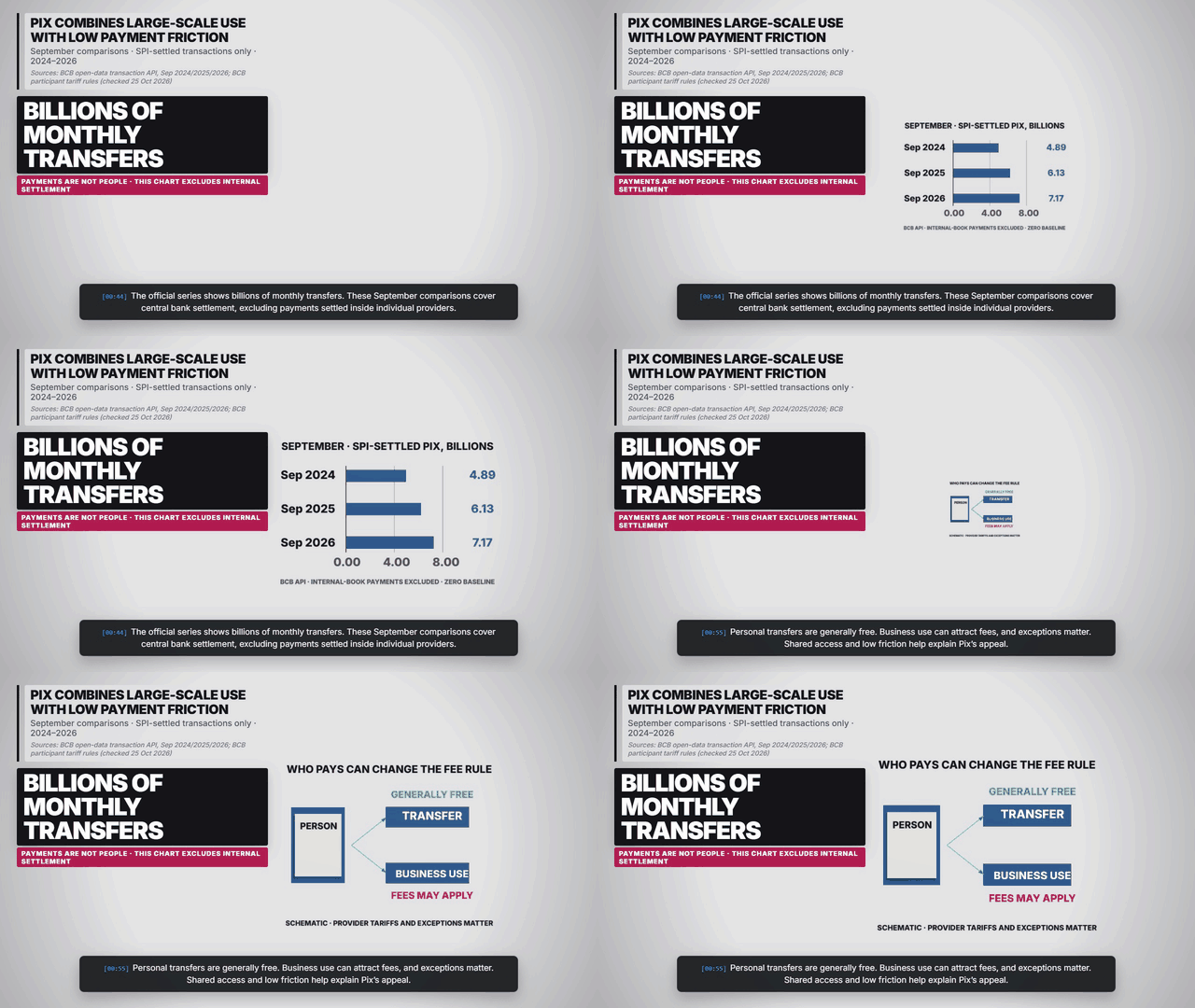
The chart compares September in 2024, 2025 and 2026, using the same SPI-only coverage. The source resource explicitly excludes payments settled on providers’ internal books. The API can return multiple reference months; we selected each exact AnoMes before summing the quantity field. Values are displayed in billions to two decimal places, with unrounded values determining bar lengths and a common zero baseline. Sources: BCB open data: Pix statistics and coverage; BCB: Pix data API resource.
These are transaction counts. They do not measure unique people, keys, consumption, financial inclusion or GDP. One person can make many payments, and a movement between accounts need not be a purchase. Broader Pix totals that include internal settlement should not be compared directly with this narrower series. Choosing the same calendar month also avoids comparing a partial year with a full one.
Why can low friction help adoption?
A common scheme connects users across participating institutions. Simple addressing and all-day availability reduce practical obstacles to payment. Ordinary personal transfers are generally free, while businesses and specified exceptions may face provider fees. This is a qualified fee statement, not a claim that every Pix transaction is free or that every merchant pays the same tariff. These characteristics help explain the system’s appeal; the chart alone does not establish the causal contribution of each one. Source: BCB: Pix participants and tariff rules.
What does Pix Automático add?
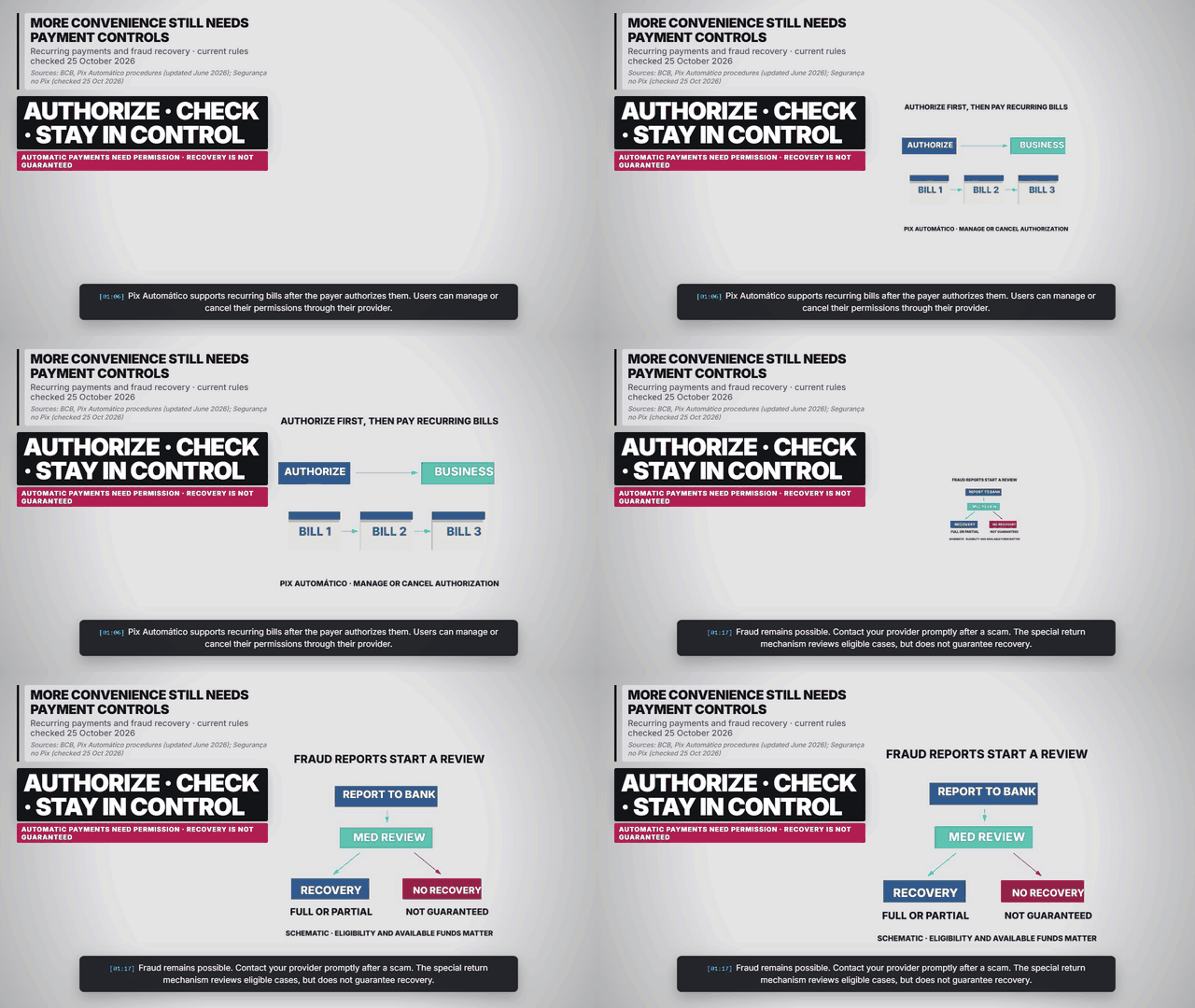
Pix Automático supports recurring bills after the payer grants permission. The current operational rules cover authorization, payment instructions and cancellation. Our calendar graphic shows repeated bills under a permission, rather than an ability for any company to debit an account freely. Managing an authorization and cancelling a particular scheduled payment are related controls with their own rules. Source: BCB: Pix Automático operational procedures, IN 513.
What happens after a scam?
Speed does not eliminate fraud. The central bank directs victims to contact their provider promptly. MED, the special return mechanism, is a review and recovery process for eligible cases. A return can be full, partial or unavailable, depending on the investigation and available funds. It is not a guaranteed refund, and ordinary commercial disagreements or mistakes in choosing a recipient are outside its stated scope. Source: BCB: Segurança no Pix.
Frequently asked questions
What is Pix?
Pix is the Brazilian instant payment scheme created by Banco Central do Brasil. It moves funds between participating accounts, including at night, on weekends and on holidays.
Is Pix a bank, wallet or new currency?
Pix is a payment scheme used through participating banks and payment providers. The payment transfers account money; it is not itself a new currency.
Does a person need a Pix key to pay?
A key simplifies addressing the recipient, but is not mandatory for making a payment. Other initiation methods include QR codes and entering account details.
Does the chart include every Pix payment?
No. The plotted open-data series covers SPI settlement and excludes transactions settled inside providers’ own books. It compares the same month and coverage across three years.
Is Pix always free?
Ordinary personal transfers are generally free. Business transactions and specified exceptions can carry fees. Users should check the applicable provider tariff rather than assume every use is free.
What does Pix Automático do?
It supports recurring bills after the payer gives permission. Users can manage or cancel authorizations, subject to the operational rules for scheduled payments.
Can MED always get money back after a scam?
No. The provider reviews eligible fraud cases. Recovery depends on the case and available funds and can be partial. Commercial disputes and sending to the wrong recipient are outside the ordinary MED scope.
Sources and coverage
- Banco Central do Brasil: Pix overview. Checked 2026-10-25. Account-to-account payment scheme, availability, keys, QR-code initiation and launch on 16 November 2020. These are service characteristics, not an uptime guarantee.
- Banco Central do Brasil: Central bank’s role. Checked 2026-10-25. BCB owns the scheme and operates DICT for addressing and SPI for settlement. Providers can participate directly or indirectly.
- BCB open data: Pix statistics and coverage. Data: September 2024, 2025 and 2026; retrieved 2026-10-25. The EstatisticasTransacoesPix resource excludes transactions settled on providers’ internal books. Exact AnoMes was selected from the returned data before summing QUANTIDADE. Counts are not users or currency values.
- BCB: Pix participants and tariff rules. Checked 2026-10-25. Ordinary personal transfers are generally free; commercial receipts, business use and other exceptions can attract provider fees. No universal merchant tariff is supplied.
- BCB: Pix Automático operational procedures, IN 513. Current text updated 2026-06-15; checked 2026-10-25. Recurring payments require authorization. Describes permission management and cancellation; the page does not replace the provider’s operational deadlines.
- BCB: Segurança no Pix. Checked 2026-10-25. Fraud prevention and MED recovery. Refunds depend on analysis and available funds; recovery can be partial and is not guaranteed. MED does not cover ordinary commercial disputes or a mistaken recipient.
- BCB: Pix data API resource. Retrieved 2026-10-25. Source of the plotted SPI-only monthly counts; the research manifest preserves the request URLs, raw sums, row counts and transformations.
Sources checked 25 October 2026. Pix is a payment scheme for transferring account money, not a new currency. DICT addresses recipients and SPI settles across institutions; simplified diagrams omit indirect participants. Same-provider settlement can remain internal. The chart compares September 2024, 2025 and 2026 SPI-settled transaction counts only, excluding internal-book Pix. It does not measure unique people, keys, spending or GDP. Personal-transfer fee exemptions have exceptions, and businesses may pay provider fees. Pix Automático requires permission. MED reviews eligible fraud cases; it does not guarantee recovery or act as a general commercial-dispute refund. Graphics are illustrative, including the R$50 transfer and weekly schedule. Eight of ten slides are graphic; recap and sources are text.
▶ Explore the five scenesCharts, maps and diagrams from the explainer