How Serbia’s Students Won at the Ballot Box
Serbia’s student-led electoral breakthrough, the ruling party’s concession, preliminary projections and the formal path to government. Checked 26 October 2026.
▶ Explore the narrated graphic explainerKey takeaways
- The ruling party conceded; the student-led movement’s breakthrough is the reported event.
- Party seat projections and the election commission’s official results are different evidence.
- The formal formation of a government follows its own parliamentary procedure.
The dated facts and their scope
| Period or item | Reported fact or figure | Scope | Source |
|---|---|---|---|
| 25 October 2026 | Ruling-party concession | AP report; parliamentary election | AP: Ruling-party defeat and concession |
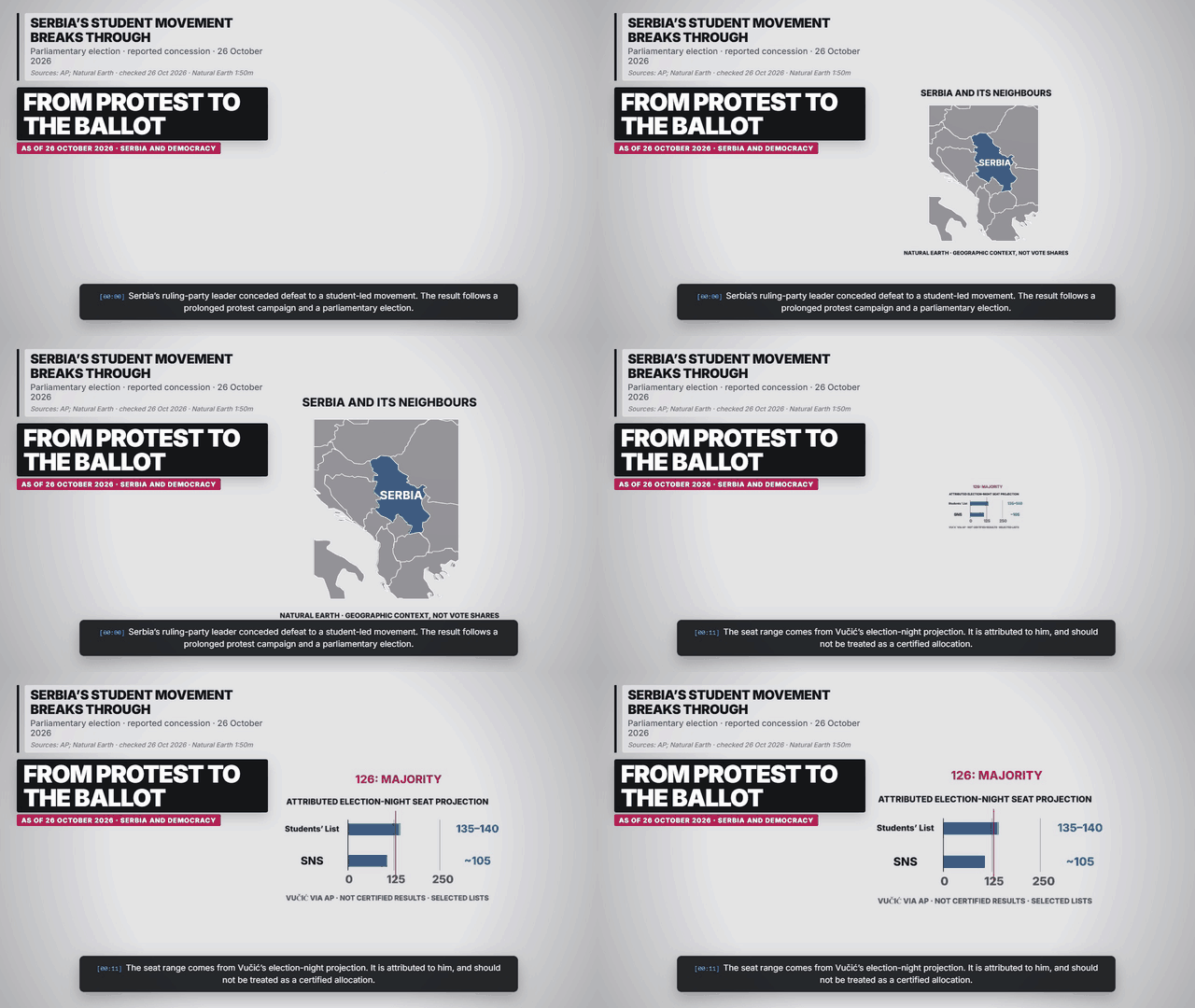
| Election-night projection | Students 135–140; SNS around 105 | Vučić’s projection; not certified allocation | AP: Ruling-party defeat and concession |
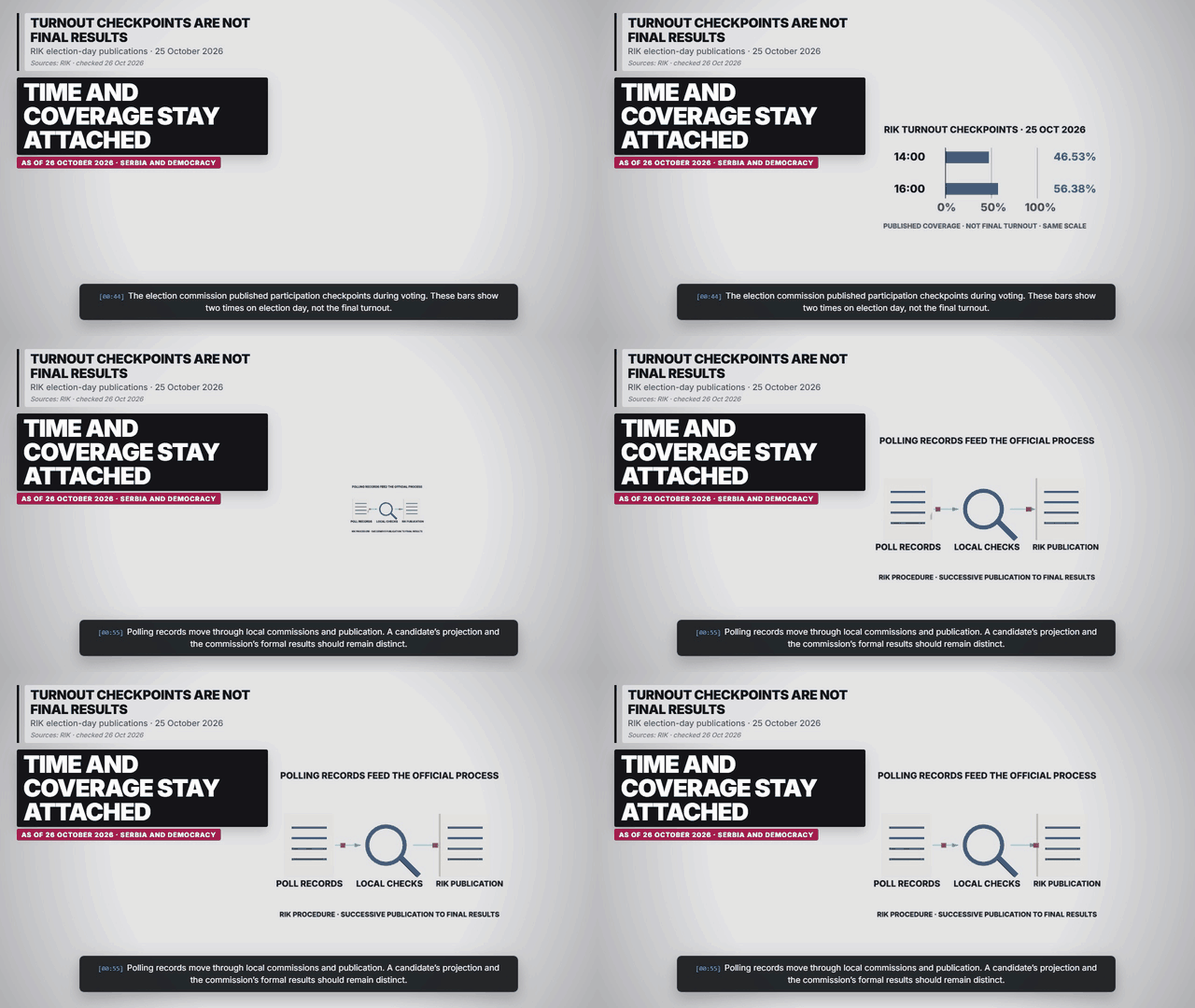
| 14:00 / 16:00 checkpoints | 46.53% / 56.38% | RIK published coverage; not final turnout | RIK: 14:00 participation checkpoint |
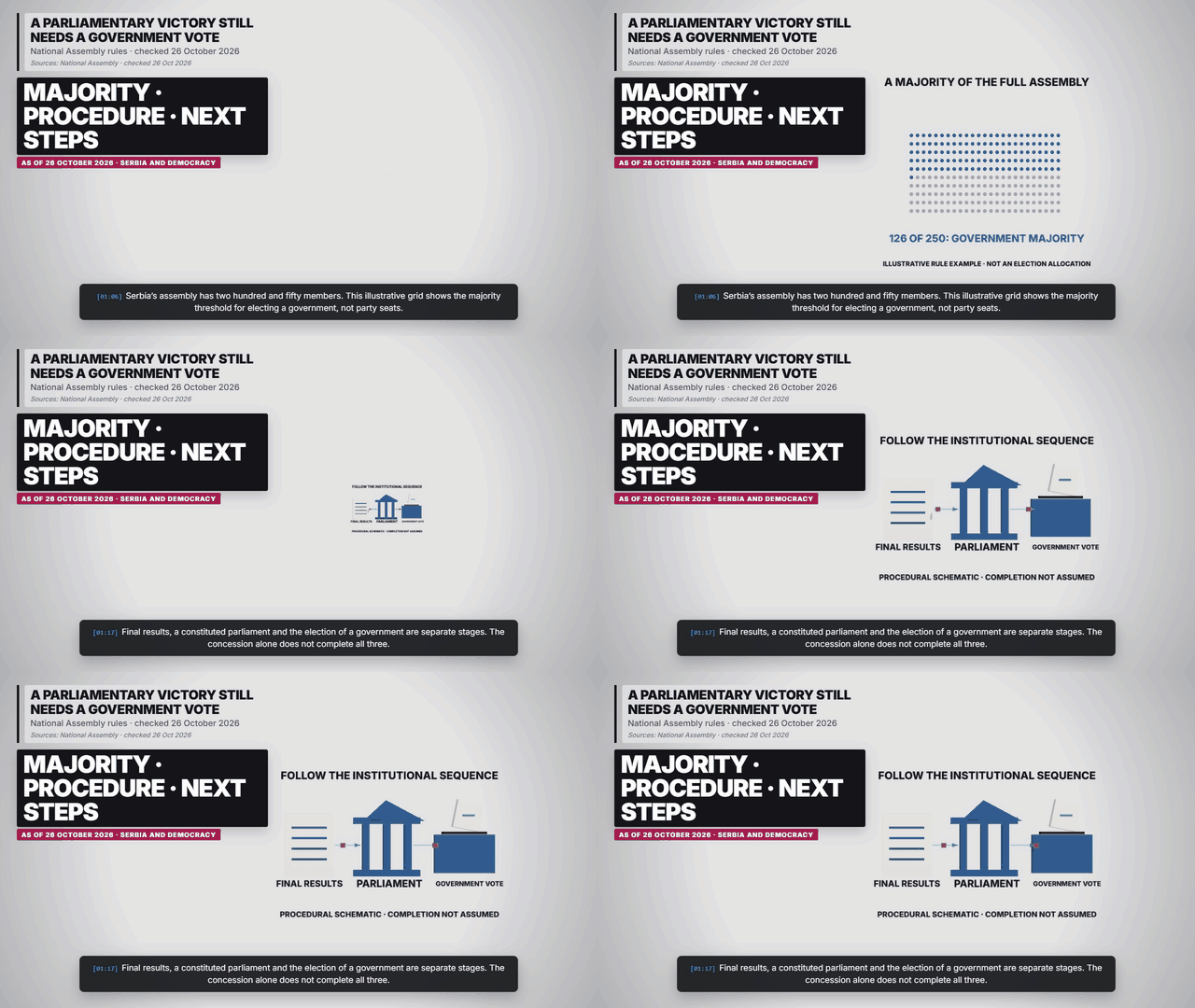
| National Assembly | 250 MPs; majority threshold 126 | Rule illustration, not election results | National Assembly: Electoral system |
What is the reported breakthrough?
AP reports that Vučić conceded his party’s defeat to the student-led movement after a long protest campaign. The page identifies a parliamentary contest and a concession. It does not describe a newly elected president or assume that the full government-formation process was completed overnight. Source: AP: Ruling-party defeat and concession.
How did the movement enter the ballot?
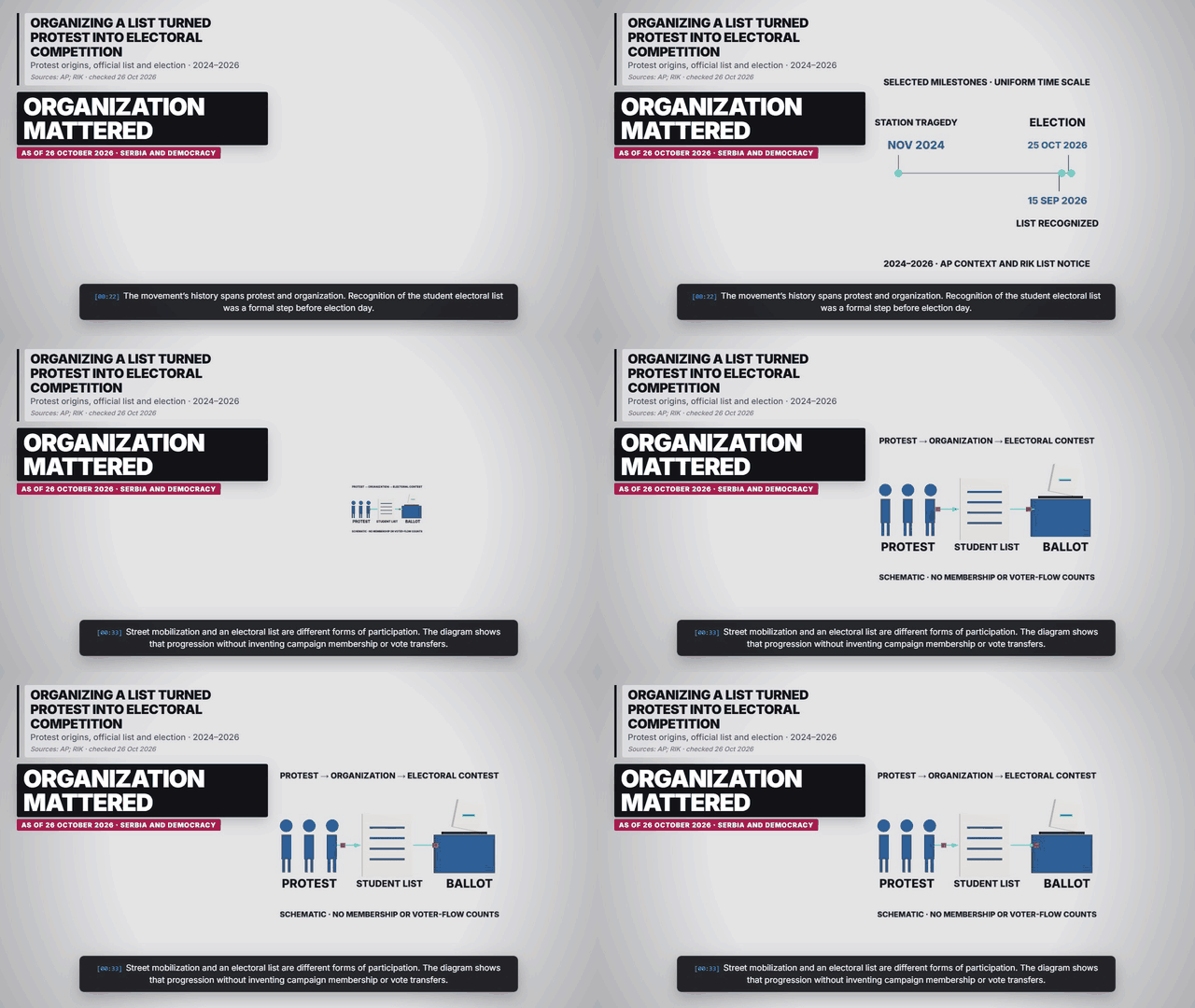
RIK formally proclaimed the student electoral list in September for the October parliamentary election. Protest participation, organizing an electoral list and voting are related stages with different forms of evidence. Recognition of a list records an official electoral step; it is not a vote tally. Source: RIK: Student list proclaimed.
How should the seat projections be read?
The displayed range belongs to the outgoing party leader’s election-night assessment. The range is retained rather than converted into a precise point. The chart also marks the majority threshold, but supplies no invented remainder for other lists and no certified allocation. Later official results can differ. Source: AP: Ruling-party defeat and concession.
What do the turnout bars establish?
RIK published participation at two checkpoints during election day. The bars use the same percentage scale and the same reported coverage. They show cumulative participation at those times; neither bar is the completed turnout. The published scope excludes Kosovo and Metohija, so the graphic should not silently expand that definition. Source: RIK: 16:00 participation checkpoint.
What happens after a concession?
RIK describes the processing and publication of polling records through the electoral system. Separately, parliament’s rules require a majority of all MPs to elect a government. Election-night acknowledgment, final results, a constituted assembly and a government vote are distinct events. A political breakthrough does not erase the procedural sequence. Source: National Assembly: Government election procedure.
How the graphics should be read
The charts and diagrams retain their dates, units and whether a figure is reported, estimated, projected or illustrative. Equal arrows do not encode quantities. Maps locate the subject and use generated country boundaries; they do not supply evidence about individual votes or live movements.
Frequently asked questions
Are the seat bars final results?
No. They display Vučić’s attributed election-night projections: Students’ List 135–140 and SNS around 105.
Does 126 mean the students won 126 seats?
No. The 126-of-250 grid is an illustrative majority threshold, not a party allocation.
Are the turnout figures final?
No. The official figures shown are 14:00 and 16:00 checkpoints for RIK’s stated coverage.
Charts, maps and diagrams from the explainer
Sources and reporting scope
- AP: Ruling-party defeat and concession. 2026-10-25/26. Vučić conceded. His election-night projection put Students’ List at 135–140 seats and SNS around 105; those are attributed party projections, not certified allocations.
- RIK: Student list proclaimed. 2026-09-15. Official recognition of the student electoral list for the 25 October parliamentary election.
- RIK: Results procedure after polls closed. 2026-10-25 20:15. Polling records go through local commissions and publication; official results are released progressively until final determination.
- RIK: 14:00 participation checkpoint. 2026-10-25. 46.53% turnout at 14:00 in the published coverage, Serbia excluding Kosovo and Metohija; not final turnout.
- RIK: 16:00 participation checkpoint. 2026-10-25. 56.38% turnout at 16:00 for the same published geographic coverage; not final turnout.
- National Assembly: Government election procedure. Checked 2026-10-26. Government needs a majority of all MPs, followed by an oath. A concession does not complete these steps.
- National Assembly: Electoral system. Checked 2026-10-26. 250 MPs; official rules for constitution of the Assembly. The majority-rule example uses 126 of 250 and is not a party result.
- Natural Earth: 1:50m country boundaries. v5.1.2; generated 26 Oct 2026. Shared-projection geographic context. Edge territories are clipped; boundaries do not endorse disputed territorial claims. No map shows regional vote results, live shipping or military movements.
- AP: Protest origins and student organization. 2026-09-26. Dates the station tragedy to 1 November 2024 and describes protest and electoral organizing. No casualty number is plotted.
As of 26 October 2026. AP reports the ruling-party leader’s concession to the student-led movement. The 135–140 and around 105 seat figures are Vučić’s election-night projections, not certified results. The turnout bars are official 14:00 and 16:00 checkpoints for the stated RIK geographic coverage, not final national turnout. The 126-seat illustration explains a majority rule and is not a seat allocation. Final results, parliamentary constitution and government election remain separate steps. Natural Earth borders provide geographic context, including a neutral treatment of disputed boundaries.
▶ Explore the five scenes