Why Brazil’s Election Matters to the World
Brazil’s 25 October 2026 runoff, its export connections and the Amazon: a graphic explainer with dated official data. Snapshot at 13:40 UTC, before the result.
▶ Explore the narrated graphic explainerKey takeaways
- Today’s runoff follows a first round in which neither of the two leading candidates won an absolute majority of valid votes.
- Brazil’s export relationships span China, the United States and regional neighbours. Goods trade provides one concrete reason the election draws attention abroad.
- Forest policy has consequences beyond national borders. The latest forest-clearing estimate and the science of moisture recycling answer different questions.
The figures and their dates
| Period | Figure or event | Definition | Source |
|---|---|---|---|
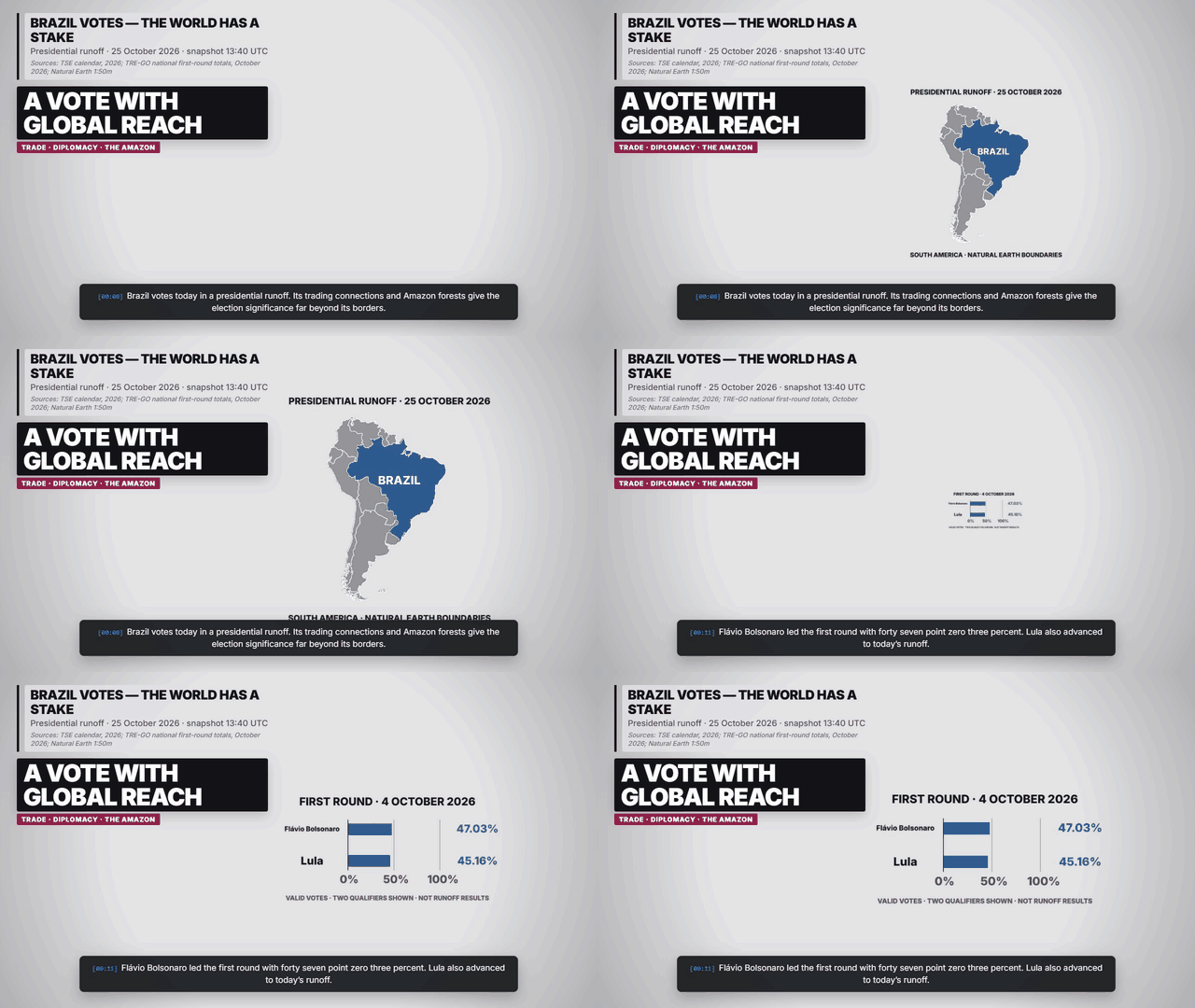
| 4 October 2026 | 47.03% / 45.16% | Flávio Bolsonaro / Lula; first-round valid votes; not runoff results | TRE-GO: First-round national presidential totals |
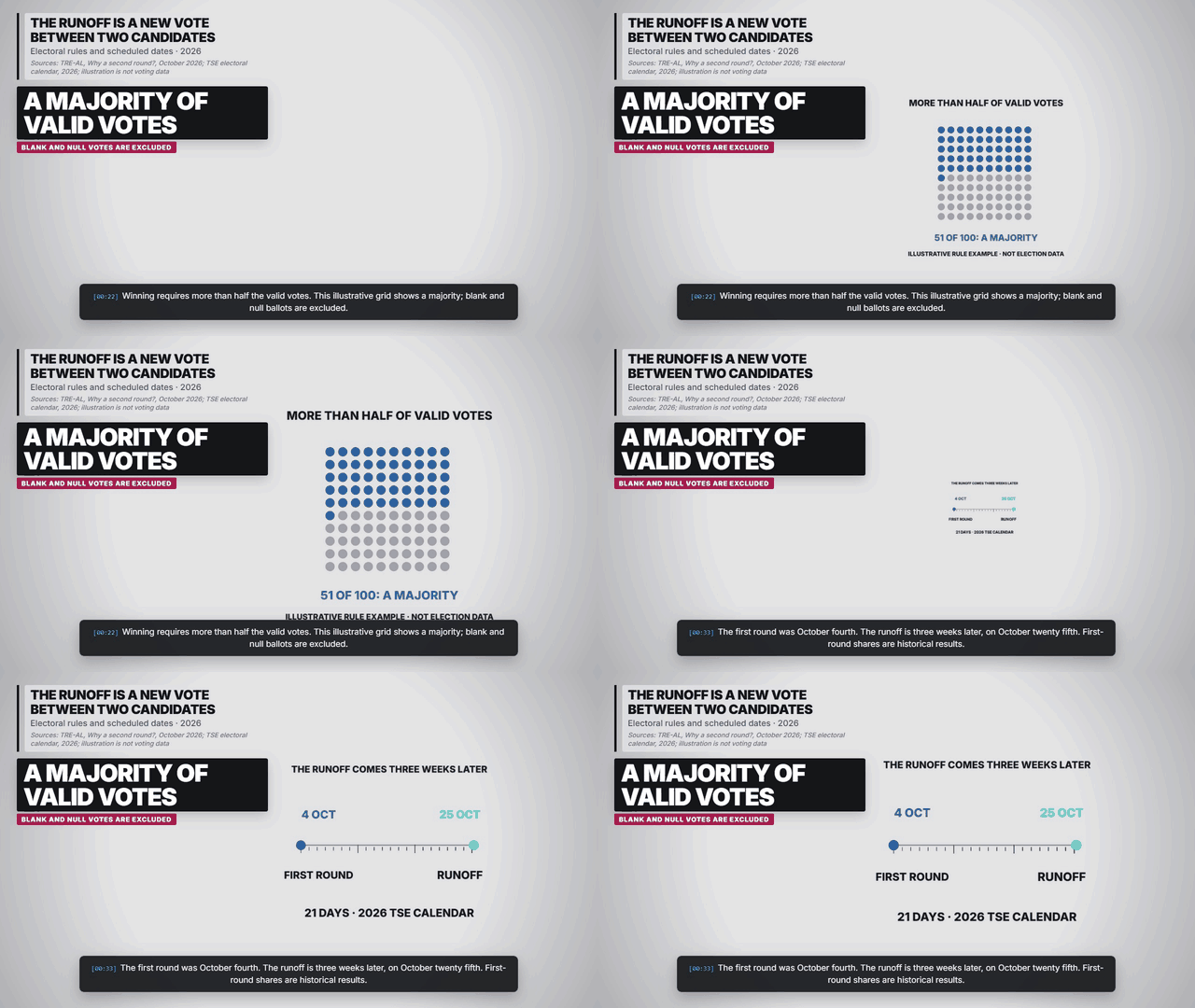
| 25 October 2026 | Presidential runoff | Scheduled election date; no winner asserted at 13:40 UTC | TSE: 2026 electoral calendar |
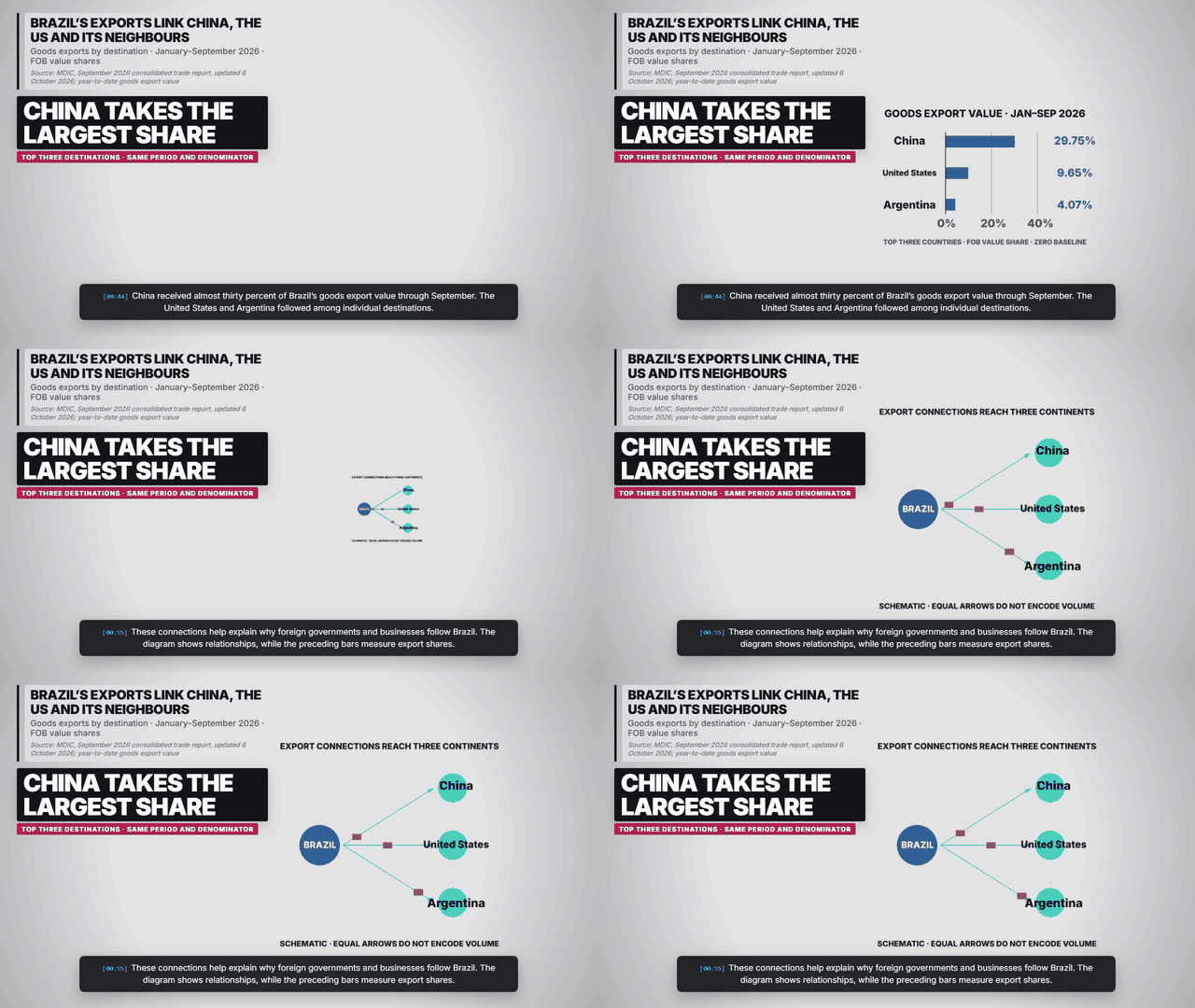
| January–September 2026 | 29.75% / 9.65% / 4.07% | China / US / Argentina; shares of goods export FOB value | MDIC: September 2026 consolidated trade report |
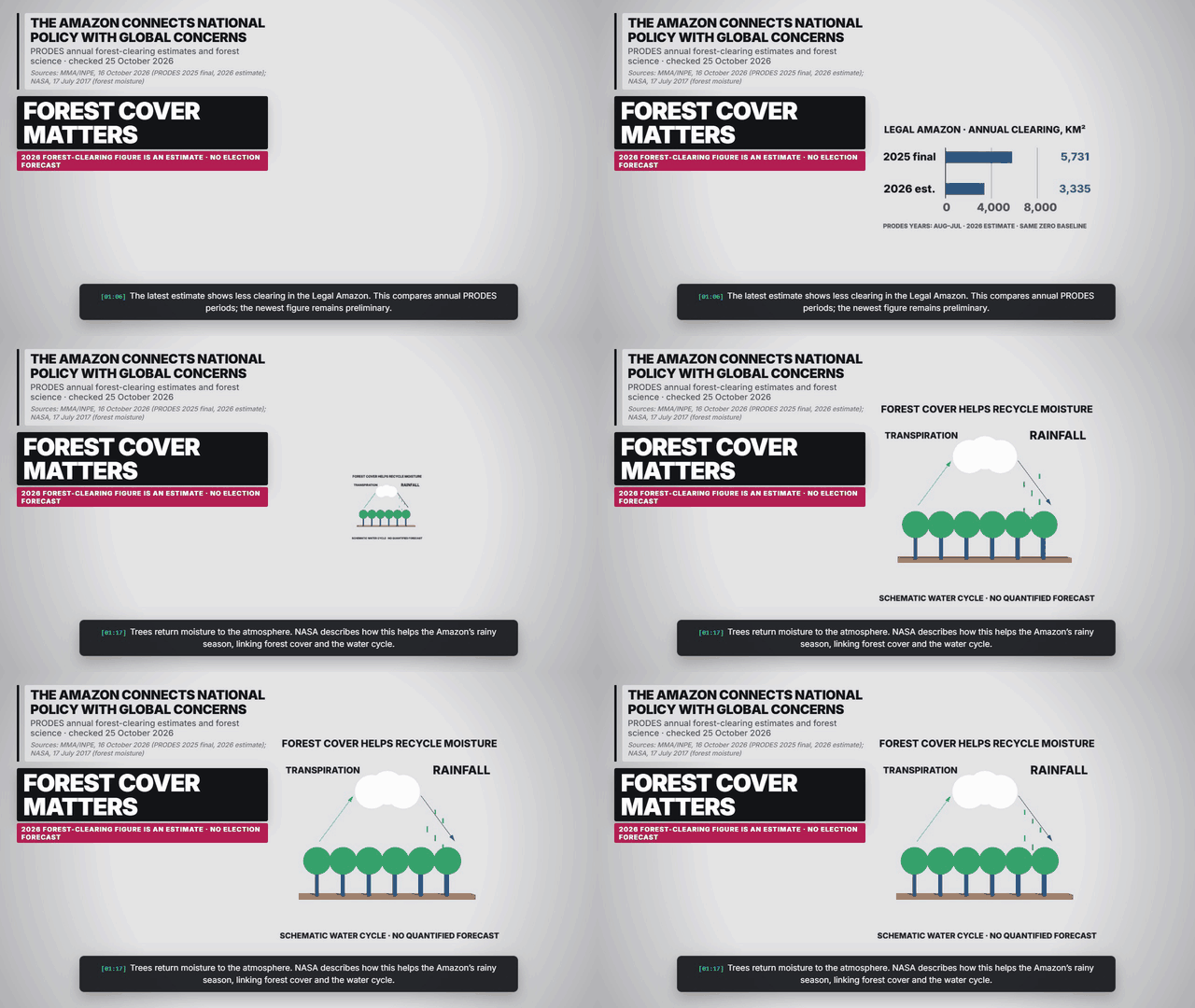
| PRODES 2025 | 5,731 km² | Consolidated; August 2024–July 2025; Legal Amazon | MMA / INPE: Annual deforestation rates |
| PRODES 2026 | 3,335 km² est. | Preliminary; August 2025–July 2026; same region and measure | MMA / INPE: Annual deforestation rates |
What is happening today?
Brazil is voting in a presidential runoff between President Luiz Inácio Lula da Silva and Senator Flávio Bolsonaro. The official calendar places the two election rounds on 4 and 25 October. This article was checked at 13:40 UTC on 25 October, before a runoff result; it does not call the race. Follow AP: Brazil votes in a presidential runoff for the news context and TSE’s official results service for the electoral count.
Why is there a second round?
The rule requires more than half the valid votes. Blank and null ballots are excluded from that denominator. If nobody reaches an absolute majority, the leading two candidates face a new vote. In the first round, Flávio Bolsonaro received 47.03% and Lula 45.16% of valid votes. Those percentages describe a completed earlier election round, rather than a poll or a partial count today. Sources: TRE-AL: Why a second round?; TRE-GO: First-round national presidential totals.
Why does the world follow Brazil’s choice?
One way to answer is to look at actual economic relationships. In the first nine months of 2026, China accounted for 29.75% of Brazil’s goods export value, followed by the United States at 9.65% and Argentina at 4.07%. These are shares of FOB dollar value, not physical quantities, services trade or a full-year total. The three selected destinations are not a complete partition of exports. The chart uses one common zero baseline and one period. Source: MDIC: September 2026 consolidated trade report.
Those connections give businesses and governments abroad a practical interest in Brazil’s policies. That is an interpretation of the trade evidence, rather than a prediction that either candidate will produce a particular trade or market outcome. The relationship diagram uses equal arrows: it identifies connections and does not encode volumes or trace shipping routes.
What does the latest Amazon report show?
The official October update reports 3,335 square kilometres of clearing for PRODES 2026 in the Legal Amazon, compared with a consolidated 5,731 square kilometres for PRODES 2025. The 2026 number remains an estimate. PRODES years span August through July: the newer period runs from 1 August 2025 to 31 July 2026. This is an annual forest-clearing measure within a specified region, not a measure of all environmental harm or a forecast. Source: MMA / INPE: Annual deforestation rates.
The explainer keeps both bars on the same zero-based scale and labels the newer figure “est.” It makes no claim that an election result has caused data measured before that result. Later consolidated figures can revise the preliminary observation.
Why is forest cover also a water story?
Trees release water through transpiration. NASA describes research linking Amazon forest moisture with the onset of the rainy season, which helps explain why changes in forest cover matter beyond the loss of trees alone. The animated trees, clouds and rain illustrate that mechanism. They supply no numerical model, tipping-point deadline or prediction of a future government’s effect. Source: NASA: The Amazon makes its own rainy season.
What should viewers watch next?
Start with the official count and the electoral authority’s eventual result. Then examine decisions and implementation on trade and forest protection, with the date and scope of each announcement attached. Electoral promises, enacted rules and measured outcomes are different evidence. This page explains why the vote matters without assigning a winner or forecasting market prices.
Frequently asked questions
Who is in Brazil’s 2026 presidential runoff?
Lula and Flávio Bolsonaro are the two candidates in the 25 October runoff. This page’s 13:40 UTC snapshot precedes the runoff result.
Are the vote bars today’s results?
No. They show 4 October first-round valid-vote shares: Flávio Bolsonaro 47.03% and Lula 45.16%, according to the electoral court. The runoff is a separate vote.
What do Brazil’s export shares measure?
MDIC reports January–September 2026 shares of goods export FOB value: China 29.75%, United States 9.65%, Argentina 4.07%. These selected destinations do not add up to all exports.
Is the 2026 Amazon deforestation figure final?
No. The 3,335 km² PRODES 2026 figure is an estimate for August 2025–July 2026 in the Legal Amazon. The comparison is 5,731 km² consolidated for PRODES 2025.
Does the forest diagram predict an election’s climate effects?
No. It illustrates forest transpiration and moisture recycling described in NASA research. It contains no quantified forecast or claim about a candidate’s future impact.
Sources and reporting cutoff
- TSE: 2026 electoral calendar. 2026. First round 4 October; runoff 25 October. Official calendar, checked 25 October.
- TRE-GO: First-round national presidential totals. October 2026. National valid-vote shares: Flávio Bolsonaro 47.03%; Lula 45.16%. These are first-round results, not runoff totals.
- TRE-AL: Why a second round?. October 2026. Absolute majority of valid votes; blank and null ballots excluded. Top two candidates proceed if no majority.
- MDIC: September 2026 consolidated trade report. 2026-10-06. January–September 2026 goods export FOB value shares: China 29.75%, United States 9.65%, Argentina 4.07%. Selected top three countries, not a complete partition.
- MMA / INPE: Annual deforestation rates. 2026-10-16. Legal Amazon PRODES: 2025 consolidated 5,731 km²; 2026 estimate 3,335 km². PRODES years run August–July, not calendar years. The newest estimate is preliminary.
- NASA: The Amazon makes its own rainy season. 2017-07-17. Scientific background on forest transpiration and rainy-season onset, not a quantified election forecast.
- Natural Earth: 1:50m country boundaries. v5.1.2. Public-domain geography generated from cached source data. Shared regional projection; Brazil highlighted in place. Distant territories omitted.
- AP: Brazil votes in a presidential runoff. 2026-10-25. Current reporting on the runoff between Lula and Flávio Bolsonaro. News checked at 13:40 UTC; no winner is asserted.
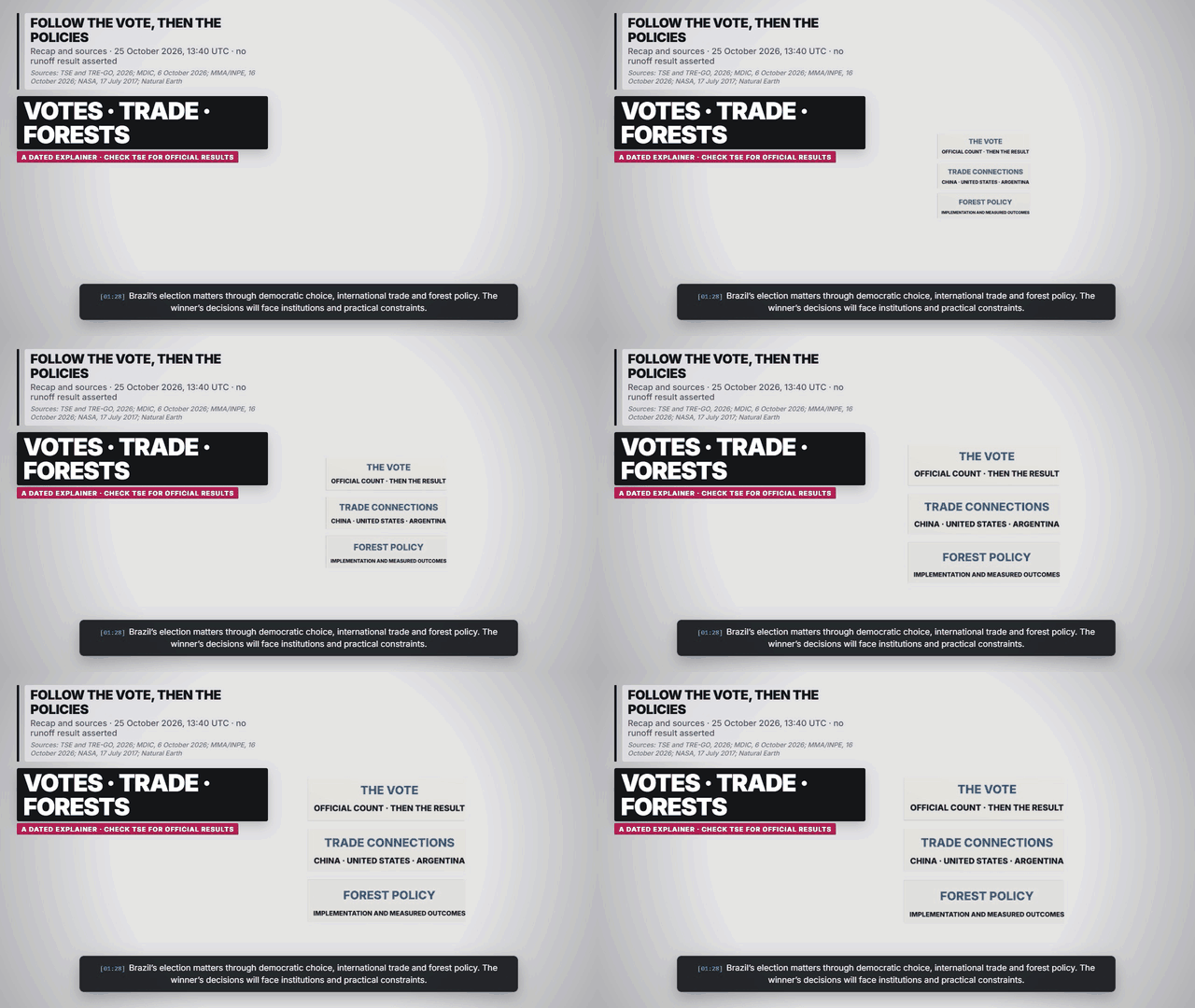
Snapshot: 25 October 2026, 13:40 UTC, before a runoff result. First-round percentages refer to 4 October valid votes; only the two runoff qualifiers are shown. Trade shares refer to January–September 2026 goods export FOB value, not volumes or full-year totals. Legal Amazon clearing is measured in square kilometres over August–July PRODES years: 2025 is consolidated; 2026 remains an estimate. Diagrams of votes, export connections and forest moisture are explicitly illustrative, not polls, shipping routes or quantified forecasts. Eight of ten slides are graphic; recap and sources are text. Check TSE separately for official results.
▶ Explore the five scenesCharts, maps and diagrams from the explainer