Full transcript
The narration below matches the explainer. Its original reporting dates and qualifications still apply.
A TRADING COMPANY BECAME A COLONIAL POWER
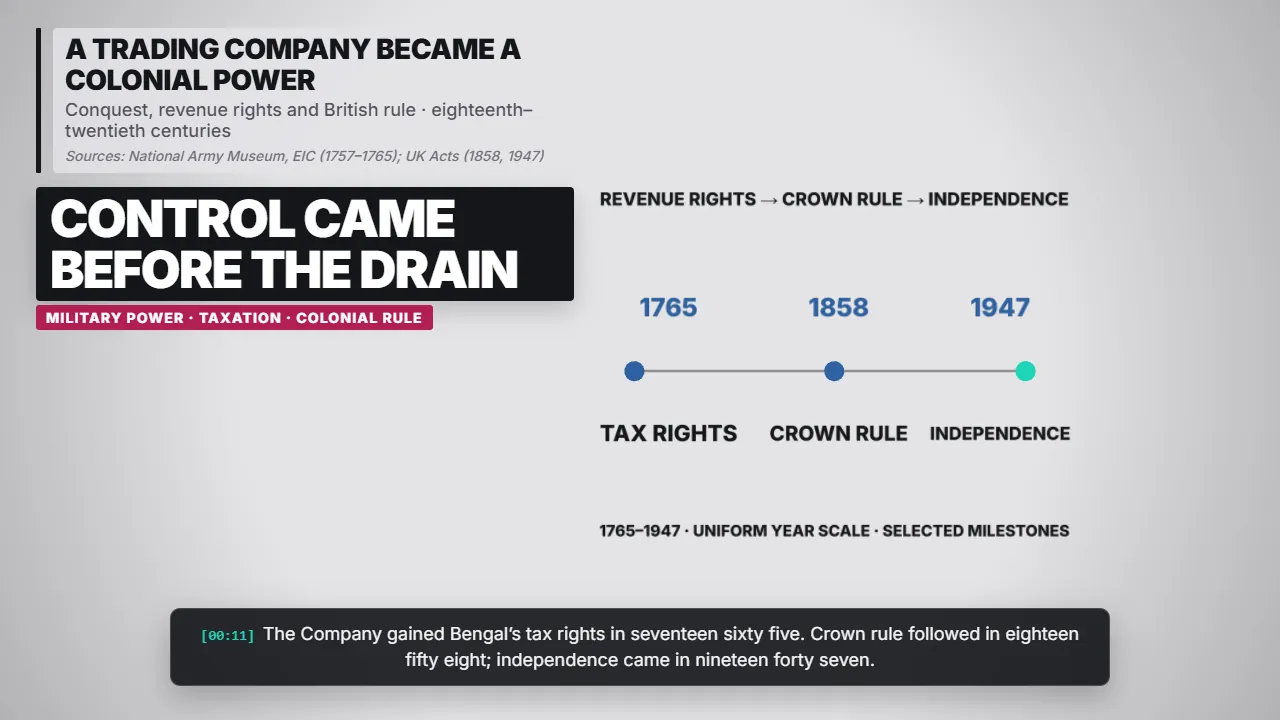
Britain’s extraction of Indian wealth rested on political power. The East India Company used military victories to secure control over revenues.
The Company gained Bengal’s tax rights in seventeen sixty five. Crown rule followed in eighteen fifty eight; independence came in nineteen forty seven.
Sources: National Army Museum, EIC (1757–1765); UK Acts (1858, 1947)
COLONIAL CONTROL CHANGED WHO BENEFITED FROM REVENUE
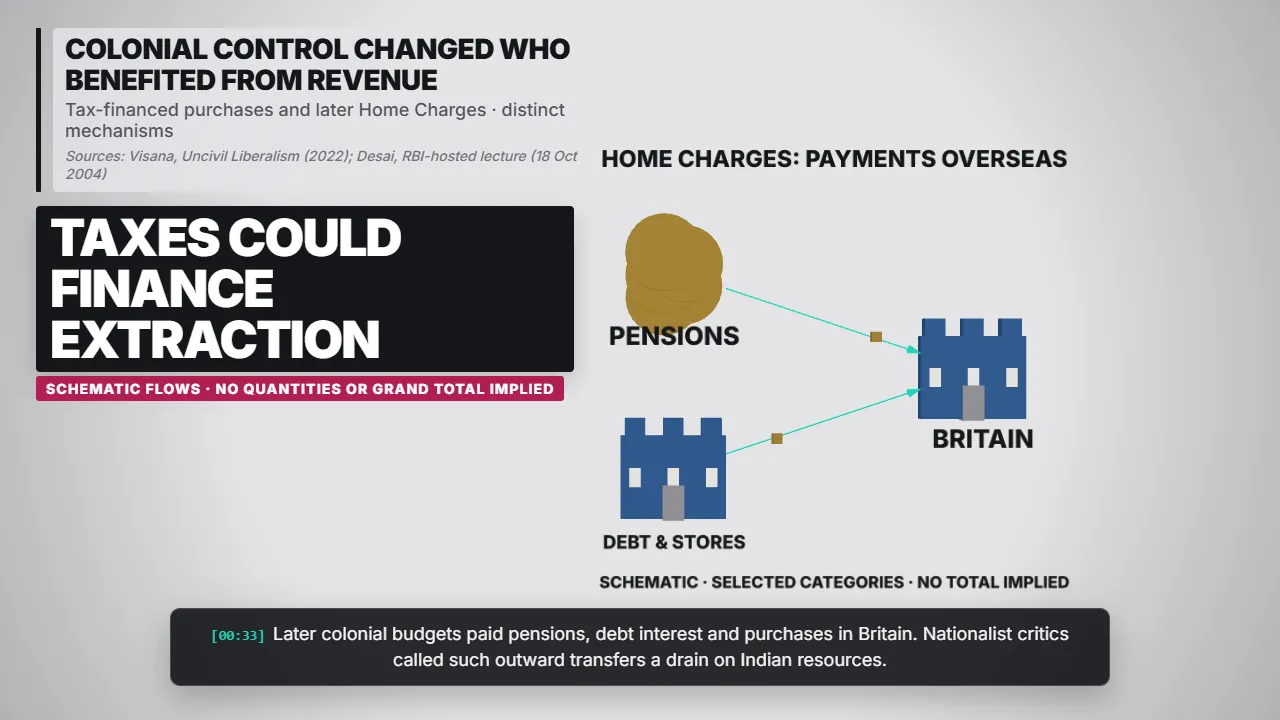
Indian tax revenues could finance purchases of Indian exports. Goods travelled abroad while their financing drew on resources raised inside India.
Later colonial budgets paid pensions, debt interest and purchases in Britain. Nationalist critics called such outward transfers a drain on Indian resources.
Sources: Visana, Uncivil Liberalism (2022); Desai, RBI-hosted lecture (18 Oct 2004)
INDIA’S INDUSTRIAL POSITION CHANGED DRAMATICALLY
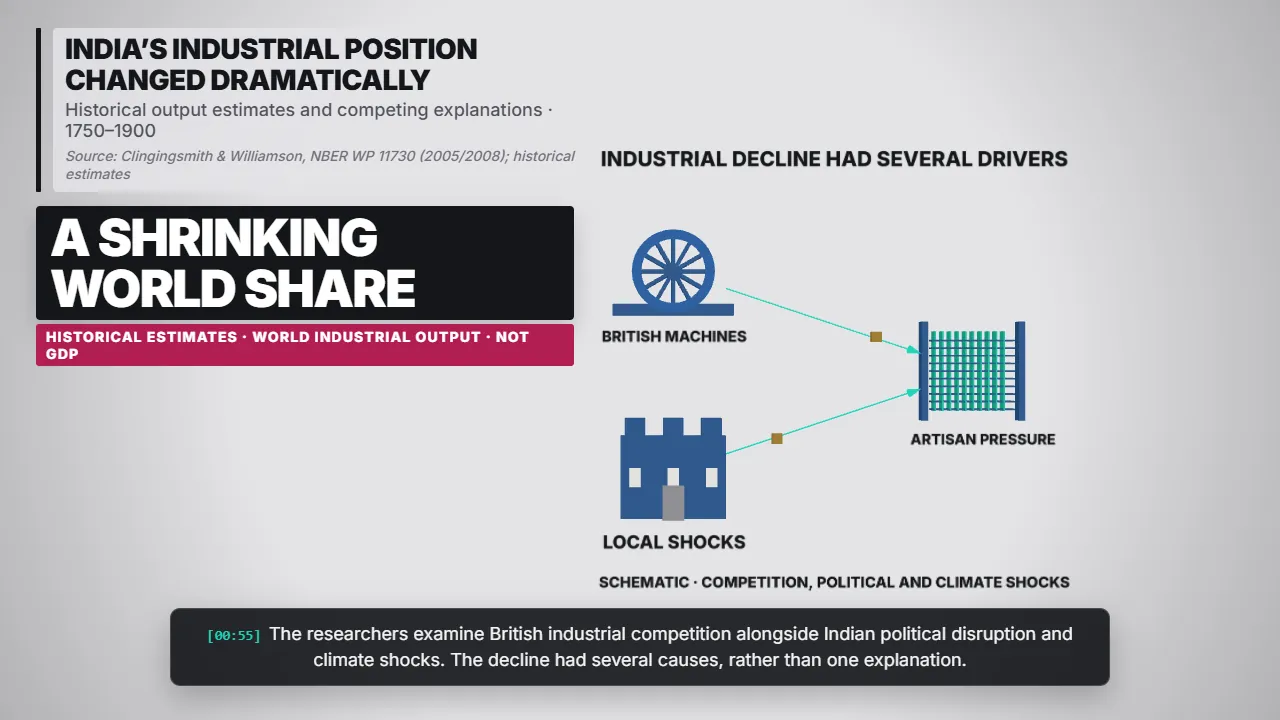
One influential study cites India’s share of world industrial output falling from about twenty five percent to about two percent.
The researchers examine British industrial competition alongside Indian political disruption and climate shocks. The decline had several causes, rather than one explanation.
Source: Clingingsmith & Williamson, NBER WP 11730 (2005/2008); historical estimates
A TAX ON A BASIC NECESSITY BECAME A POLITICAL FLASHPOINT
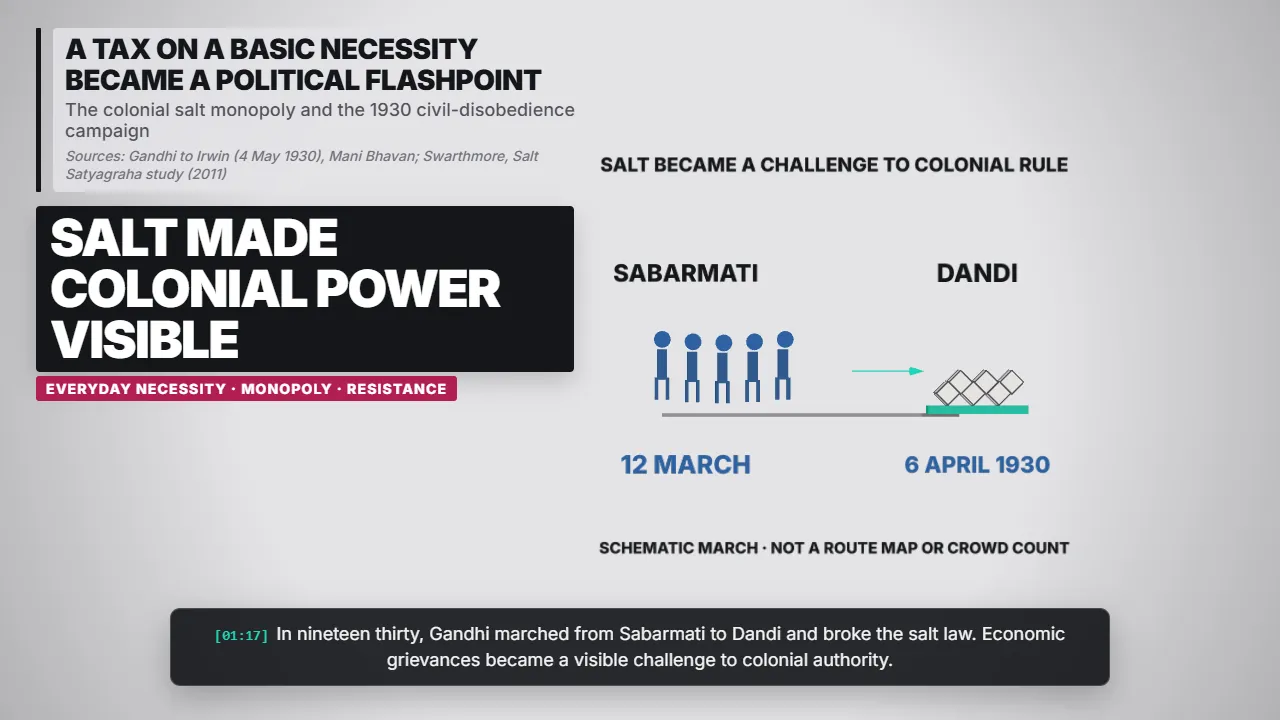
Colonial salt controls reached an everyday necessity. Gandhi demanded an end to the salt tax and restrictions on private salt making.
In nineteen thirty, Gandhi marched from Sabarmati to Dandi and broke the salt law. Economic grievances became a visible challenge to colonial authority.
Sources: Gandhi to Irwin (4 May 1930), Mani Bhavan; Swarthmore, Salt Satyagraha study (2011)
THE HISTORY IS CLEARER WHEN THE MECHANISMS ARE VISIBLE
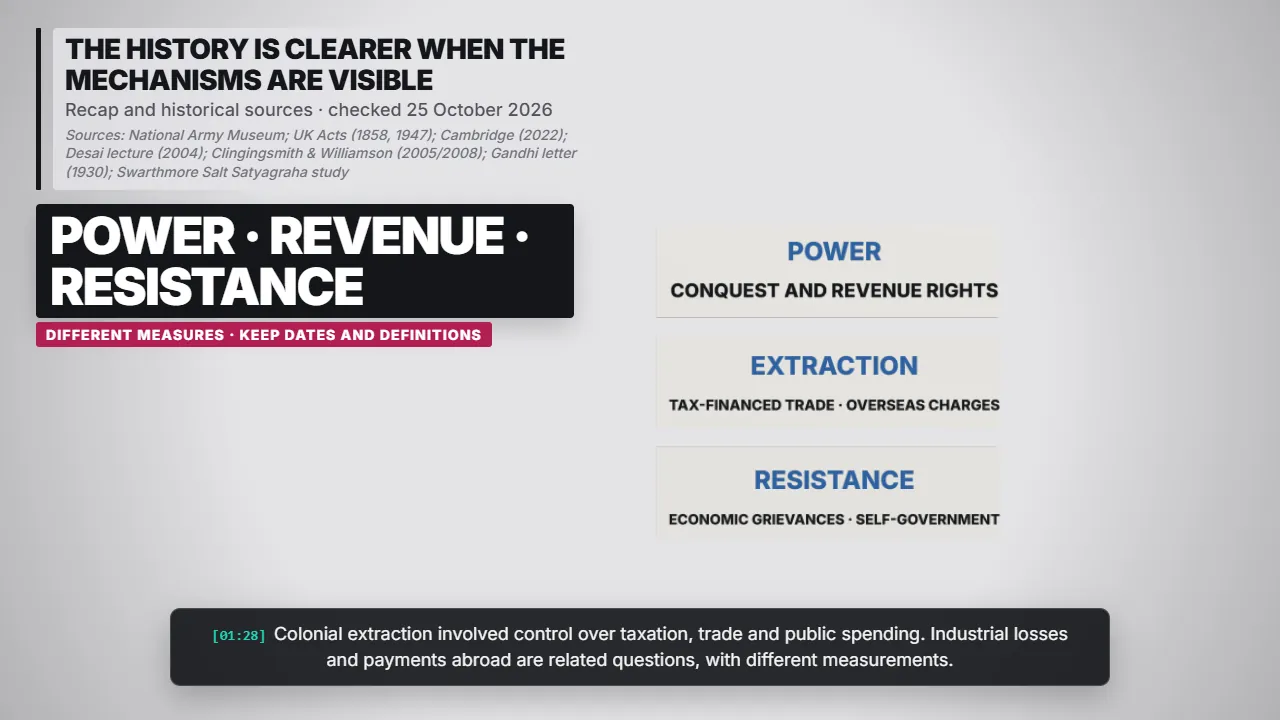
Colonial extraction involved control over taxation, trade and public spending. Industrial losses and payments abroad are related questions, with different measurements.
These sources document the mechanisms and their debates. Historical estimates need dates and definitions; they do not add up to one uncontested bill.
Sources: National Army Museum; UK Acts (1858, 1947); Cambridge (2022); Desai lecture (2004); Clingingsmith & Williamson (2005/2008); Gandhi letter (1930); Swarthmore Salt Satyagraha study
Source links
- https://www.nam.ac.uk/explore/armies-east-india-company
- https://www.legislation.gov.uk/ukpga/Vict/21-22/106/pdfs/ukpga_18580106_en.pdf
- https://www.legislation.gov.uk/ukpga/Geo6/10-11/30?view=extent
- https://www.cambridge.org/core/books/abs/uncivil-liberalism/conceptualizing-the-drain-theory/BBB49A4B5C2D2BE72EA99F931DDB6827
- https://www.rbi.org.in/scripts/BS_ViewBulletin.aspx?Id=5644
- https://www.nber.org/papers/w11730
- https://www.parliament.uk/about/living-heritage/transformingsociety/tradeindustry/industrycommunity/overview/textileindustries/
- https://www.gandhi-manibhavan.org/educational-resources/letter-to-lord-irwin.html
- https://nvdatabase.swarthmore.edu/content/indians-campaign-independence-salt-satyagraha-1930-1931