AI tops the Fed’s list of salient risks
Survey · As of 14 November 2026

87% name AI
AS OF 14 NOVEMBER 2026 · DATED SOURCES
Transcript

Full transcript

The narration below matches the explainer. Its original reporting dates and qualifications still apply.

Read the companion article

AI tops the Fed’s list of salient risks

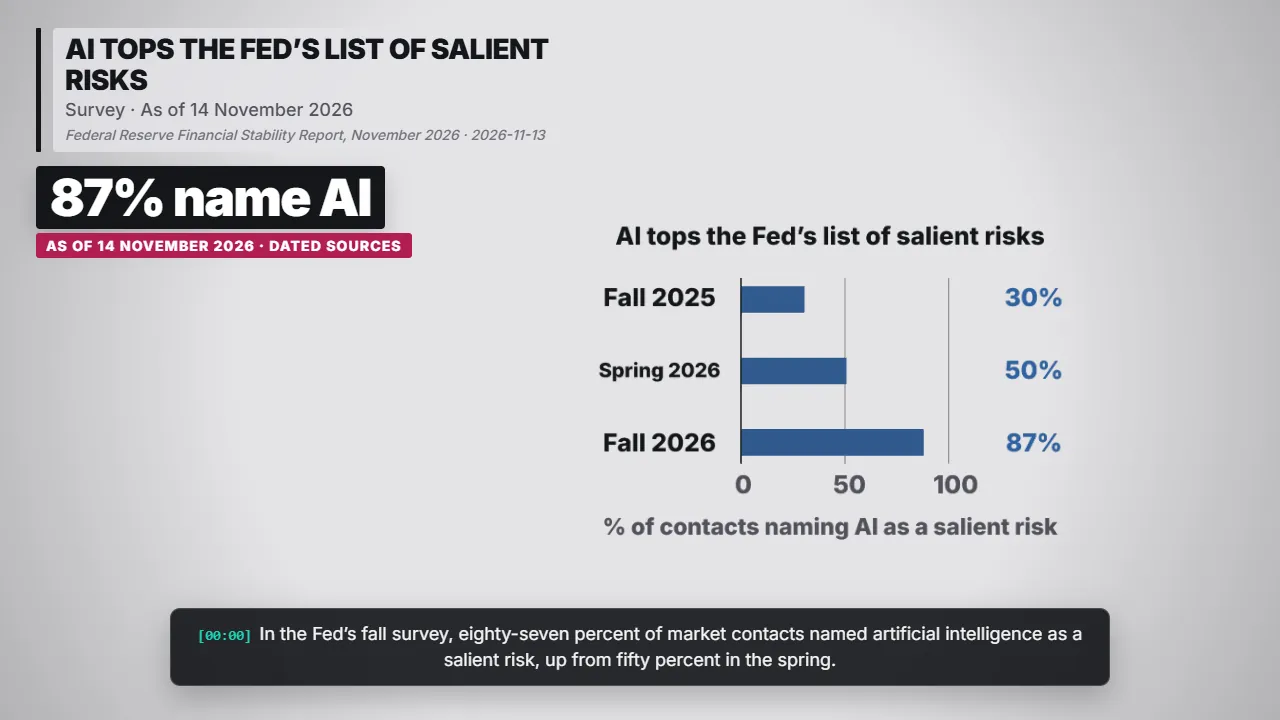
Bar chart: AI tops the Fed’s list of salient risks — 87% name AI. In the Fed’s fall survey, eighty-seven percent of market contacts named artificial intelligence as a salient risk, up from fifty percent in the spring.
AI tops the Fed’s list of salient risks — 87% name AI Federal Reserve Financial Stability Report, November 2026 · 2026-11-13

In the Fed’s fall survey, eighty-seven percent of market contacts named artificial intelligence as a salient risk, up from fifty percent in the spring.

Federal Reserve Financial Stability Report, November 2026 · 2026-11-13

AI outranks a market correction and rates
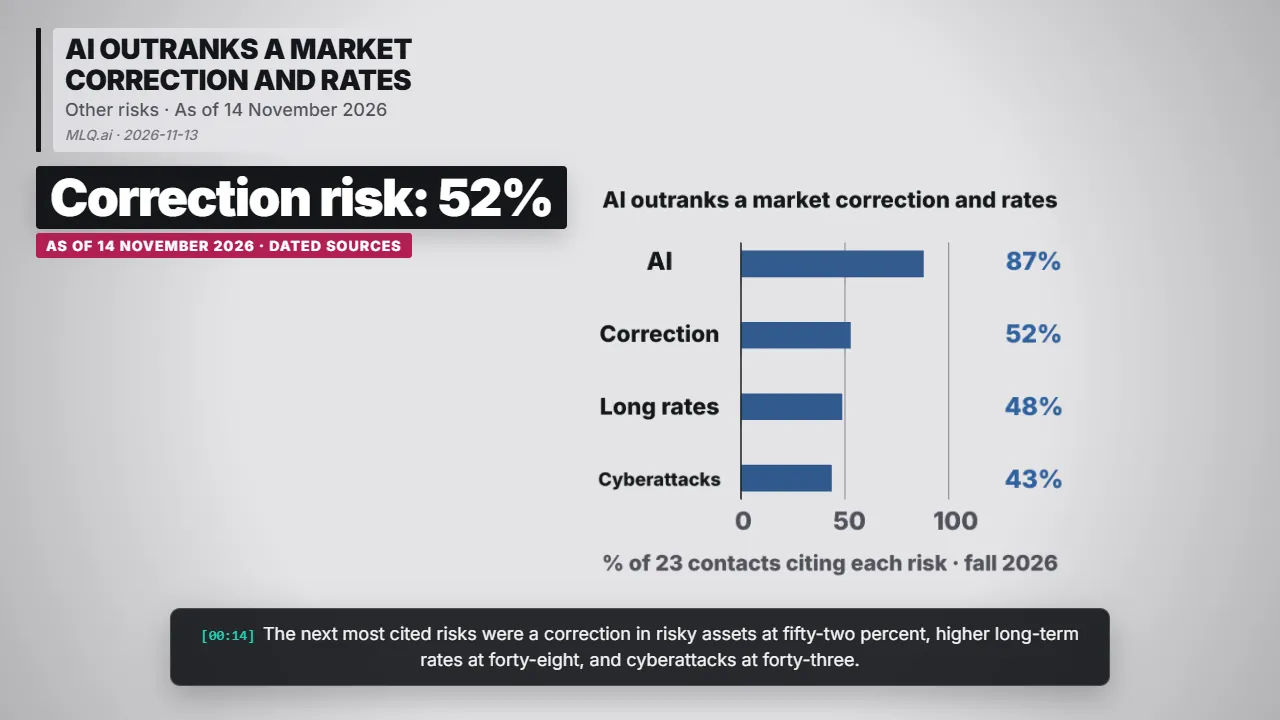
Bar chart: AI outranks a market correction and rates — Correction risk: 52%. The next most cited risks were a correction in risky assets at fifty-two percent, higher long-term rates at forty-eight, and cyberattacks at forty-three.
AI outranks a market correction and rates — Correction risk: 52% MLQ.ai · 2026-11-13

The next most cited risks were a correction in risky assets at fifty-two percent, higher long-term rates at forty-eight, and cyberattacks at forty-three.

MLQ.ai · 2026-11-13

AI-related borrowing is about five times 2023
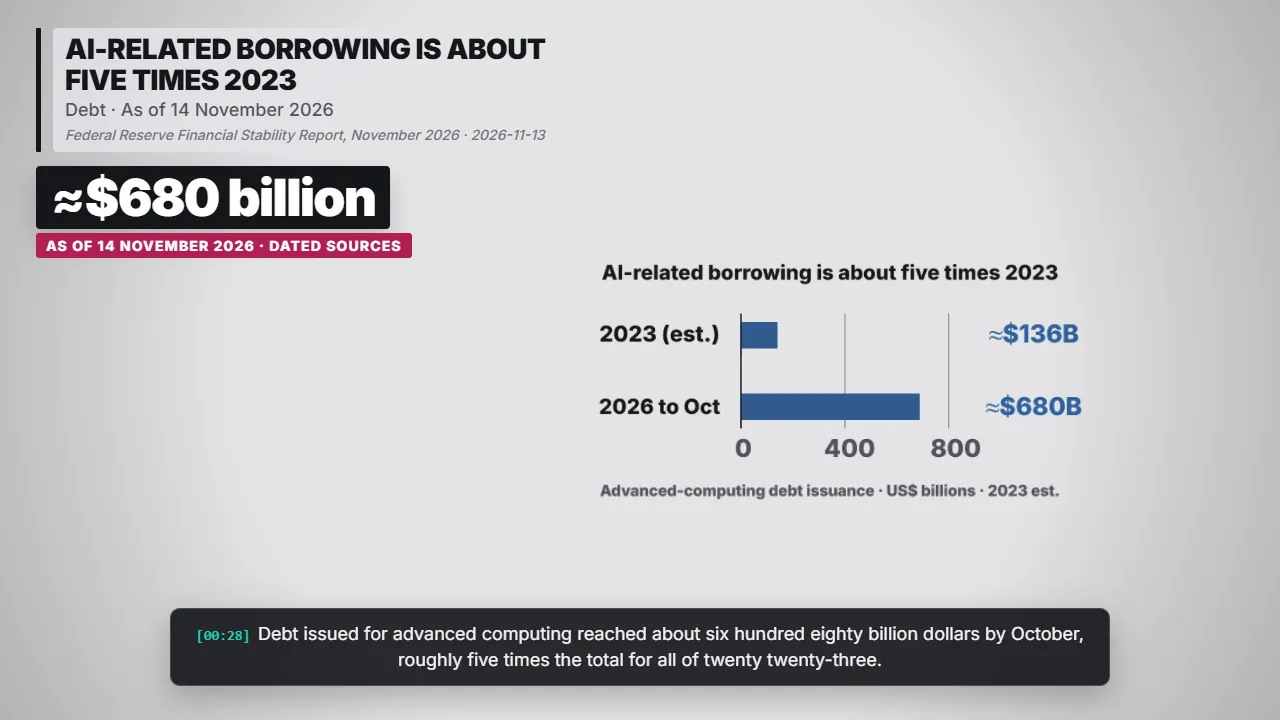
Bar chart: AI-related borrowing is about five times 2023 — ≈$680 billion. Debt issued for advanced computing reached about six hundred eighty billion dollars by October, roughly five times the total for all of twenty twenty-three.
AI-related borrowing is about five times 2023 — ≈$680 billion Federal Reserve Financial Stability Report, November 2026 · 2026-11-13

Debt issued for advanced computing reached about six hundred eighty billion dollars by October, roughly five times the total for all of twenty twenty-three.

Federal Reserve Financial Stability Report, November 2026 · 2026-11-13

AI debt’s share of bond issuance jumps
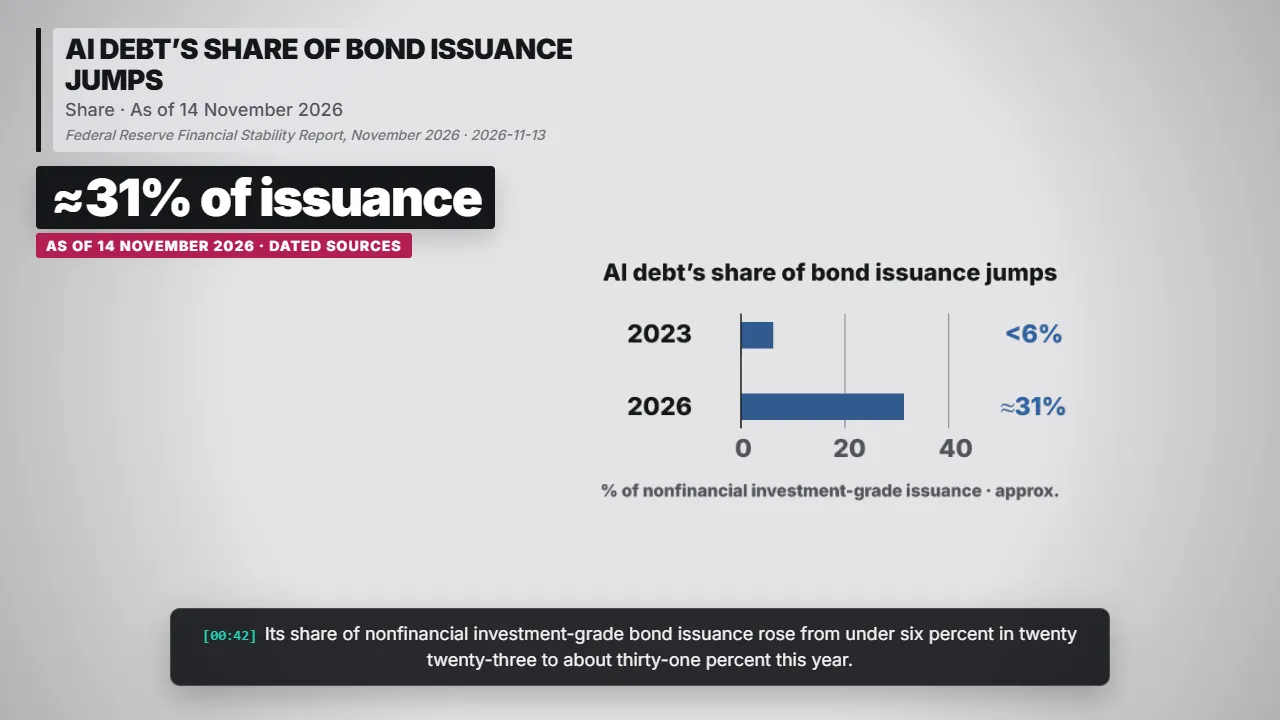
Bar chart: AI debt’s share of bond issuance jumps — ≈31% of issuance. Its share of nonfinancial investment-grade bond issuance rose from under six percent in twenty twenty-three to about thirty-one percent this year.
AI debt’s share of bond issuance jumps — ≈31% of issuance Federal Reserve Financial Stability Report, November 2026 · 2026-11-13

Its share of nonfinancial investment-grade bond issuance rose from under six percent in twenty twenty-three to about thirty-one percent this year.

Federal Reserve Financial Stability Report, November 2026 · 2026-11-13

Investors’ worries shift to AI
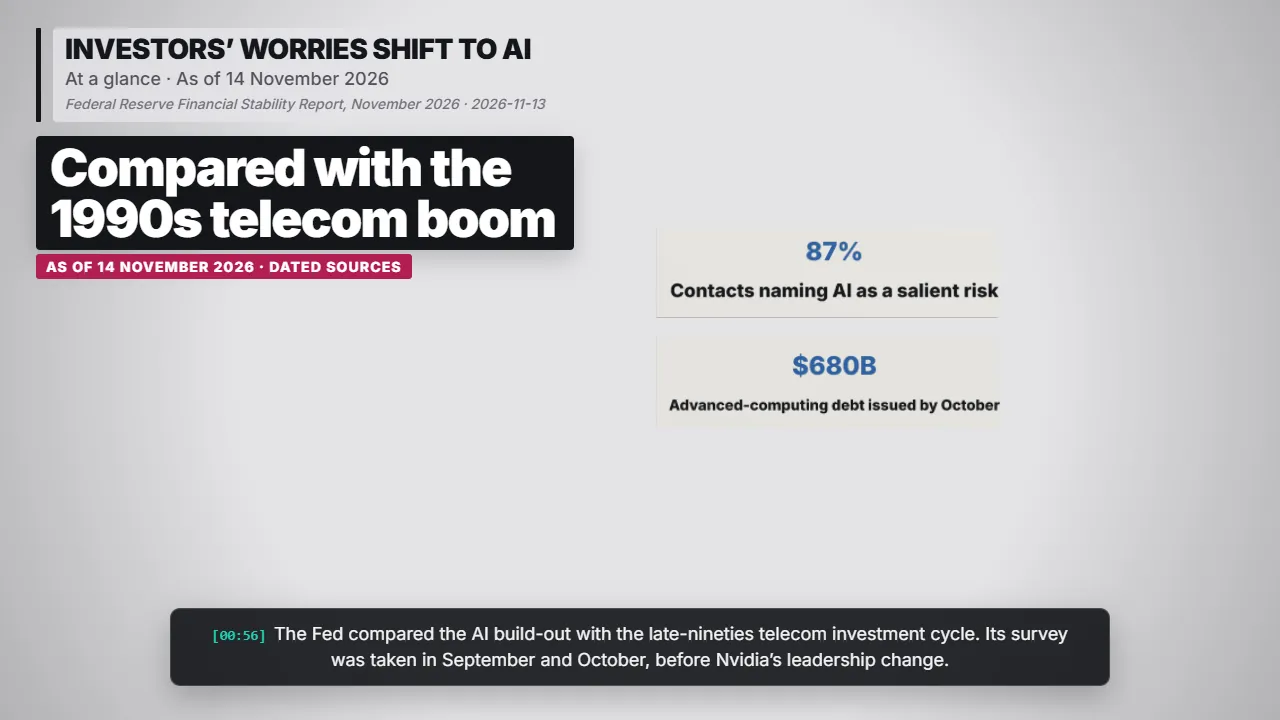
3D graphic: Investors’ worries shift to AI — Compared with the 1990s telecom boom. The Fed compared the AI build-out with the late-nineties telecom investment cycle.
Investors’ worries shift to AI — Compared with the 1990s telecom boom Federal Reserve Financial Stability Report, November 2026 · 2026-11-13

The Fed compared the AI build-out with the late-nineties telecom investment cycle. Its survey was taken in September and October, before Nvidia’s leadership change.

Federal Reserve Financial Stability Report, November 2026 · 2026-11-13

SOURCES AND NOTES

Figures come from the Federal Reserve’s November Financial Stability Report, with survey details reported by CNBC and MLQ on November thirteenth.

Federal Reserve Financial Stability Report, November 2026 · 2026-11-13

Source links

All Explainers
[00:00]
Read the full article

Fed survey: 87% of market contacts now see AI as a financial stability risk

As of 14 November 2026. The report, published 13 November, generally reflects information through late October; the survey of 23 market contacts was taken in September and October. Debt figures are Fed estimates; the 2023 bar is derived from the reported fivefold comparison and is approximate, as is the issuance share.

Federal Reserve Financial Stability Report, November 2026. 2026-11-13. Survey of salient risks, advanced-computing debt issuance and the telecom-cycle comparison.

CNBC. 2026-11-13. Reports the 87% survey result and the earlier 50% reading.

MLQ.ai. 2026-11-13. Summarizes the other most-cited risks in the survey.